You are reading: drone rules for France
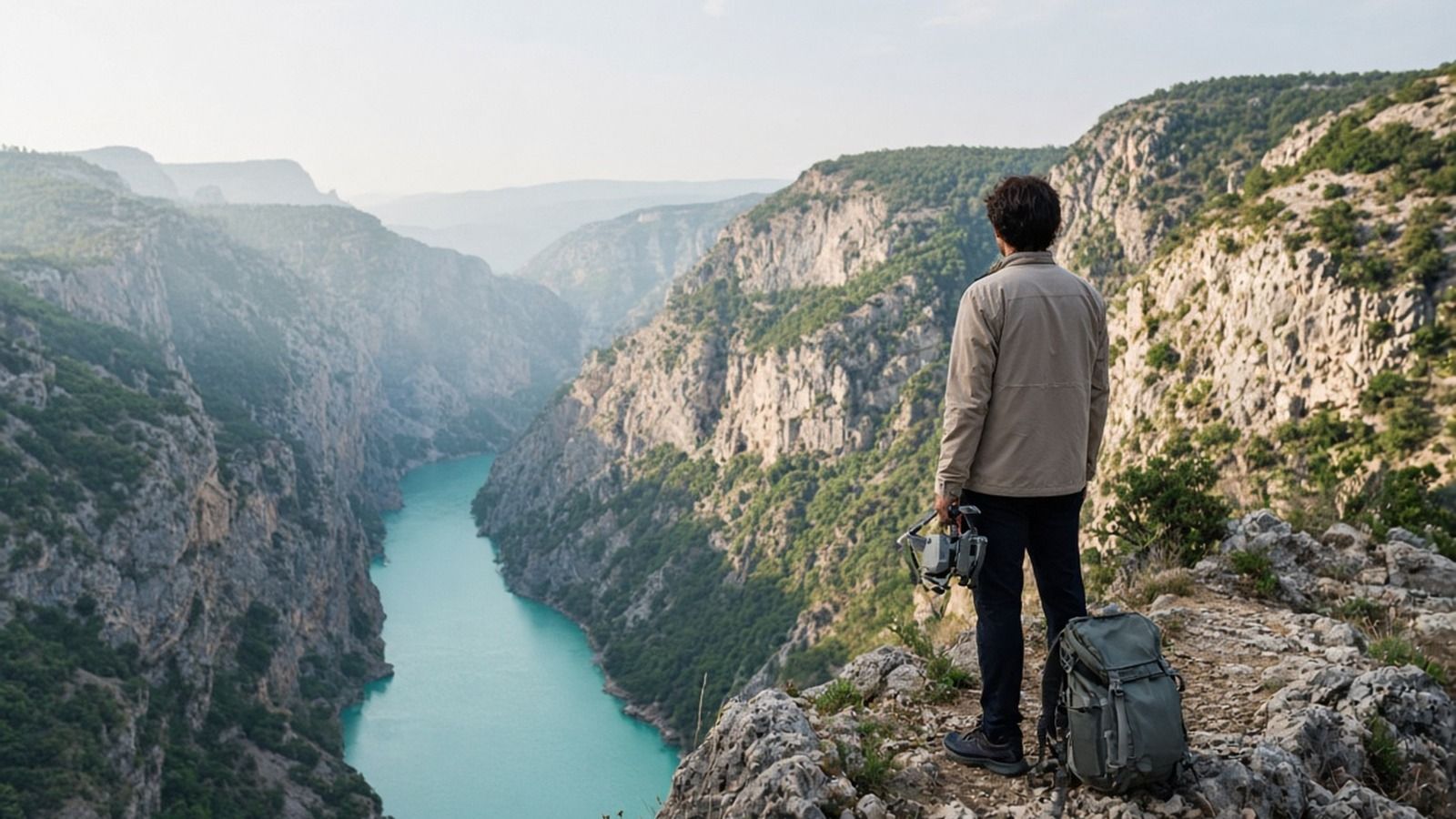
Drone rules France · Updated 2026
Flying a drone in France: what visitors and residents need to know in 2026
France applies the EU drone regulation but adds rules of its own: no drone may fly at night, flying over public space in towns is off limits, in Paris practically everywhere, and from 800 grams a drone needs a French registration and an electronic signal. This guide explains what visitors from other countries must know, what applies to residents and where to apply for what.
- EU registration valid
- No night flying
- From 800 g: AlphaTango
I am visiting France I live in France
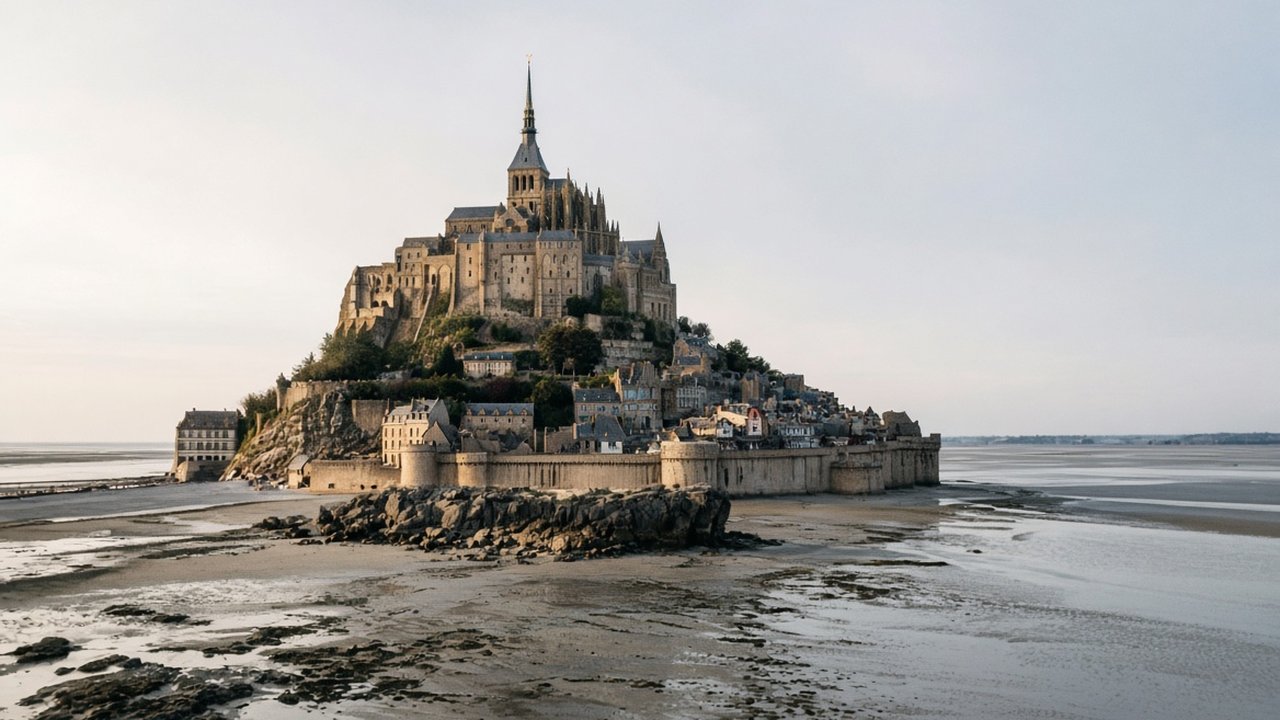
AI-generated image
Status: legal position in 2026, based on Regulation (EU) 2019/947 and the websites of Service Public and the Ministry for the Ecological Transition, which oversees the civil aviation authority DGAC. This is editorial guidance, not legal advice.
On 18 September 2026, EASA recommended in Opinion 06/2026 that registration and Remote ID should start at 100 instead of 250 grams [8]. This is not law yet. If adopted, it would apply in every EU country, including France.
The key points in 20 seconds
If you are registered as an operator in your EU country of residence, you do not register again in France [2], [4].
Drones over 800 g also need a registration on AlphaTango and a French electronic signalling device, visitors included [4].
Flying over public space in built-up areas is prohibited; in Paris, according to DGAC, any outdoor flight [3], [4].
France sets a minimum age of 14 for the open category [4].
The official restriction map is on cartes.gouv.fr; the former Géoportail has closed [7].
EU law and French rules: what applies where?
The basis is the same across the EU: Implementing Regulation (EU) 2019/947 sets out categories, subcategories and registration [1]. You register in your country of residence; registration and pilot certificates are valid in all EASA states [2]. France adds national rules that often surprise visitors: a night-flying ban, no flights over public space in towns, and registration and electronic signalling from 800 grams [3], [4].
| Topic | Rule in France | Source |
|---|---|---|
| Operator registration | In your country of residence; French residents on AlphaTango | EU 2019/947, ministry |
| Drones over 800 g | Registration on AlphaTango and French electronic signal, also for operators from other EU states | Ministry, Service Public |
| Minimum age | 14 in the open category | Ministry |
| Height | Maximum 120 m, lower near aerodromes and military zones | Service Public |
| Night flying | Prohibited, even with lights; exceptions for model aircraft sites and by the prefect | Service Public, ministry |
| Built-up areas | No flights over public space; Paris: no outdoor flights | Service Public, DGAC |
| Insurance | Not mandatory, but strict liability of the operator | DGAC |
Sources: Service Public [3], Ministry for the Ecological Transition/DGAC [4].
VisitorYou live in another country and fly on holiday
Your home registration and EU certificate are valid. From 800 g you also need AlphaTango and a French signalling device.
ResidentYou live permanently in France
You register as an operator on AlphaTango and take DGAC’s free online training.
Visiting France with a drone: your checklist
For operators from other EU states the ministry states: if you are registered at home as an EU operator, you may fly in the open category in France but must respect French restrictions [4].
Your home registration is valid in France. The operator number must be visible on the drone [2], [3].
If your drone weighs over 800 g, you need an AlphaTango registration and a French electronic signalling device [4].
A1/A3 proof of training or an A2 certificate from another EU state is recognised throughout the EU [2], [4].
Open the map on cartes.gouv.fr before every take-off. According to DGAC it is not dynamic; short-term restrictions are published by the aeronautical information service SIA [4], [7].
Night flights are prohibited, even with navigation lights [3].
Your operator number must be visible on every drone. One option is a 20 × 8 mm aluminium plate, laser-engraved with your operator number without the three secret characters. According to the seller it is made for light drones such as the DJI Mini series or Neo.

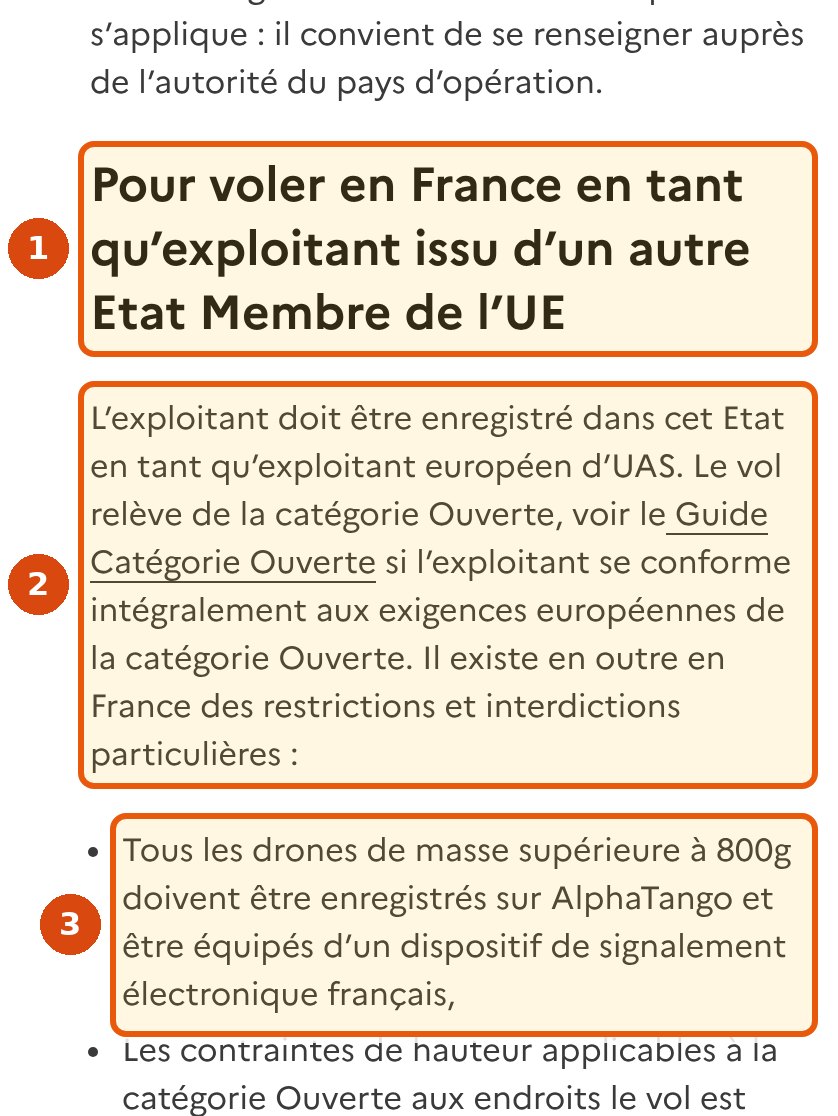
- Section for operators from another EU member state.
- Registered at home as an EU operator; France adds specific restrictions.
- Drones over 800 g must be registered on AlphaTango and carry a French electronic signalling device.
Source: Ministry for the Ecological Transition (DGAC), ecologie.gouv.fr · Etalab 2.0 licence · screenshot taken on 17 November 2026 · markings: drohnen.de
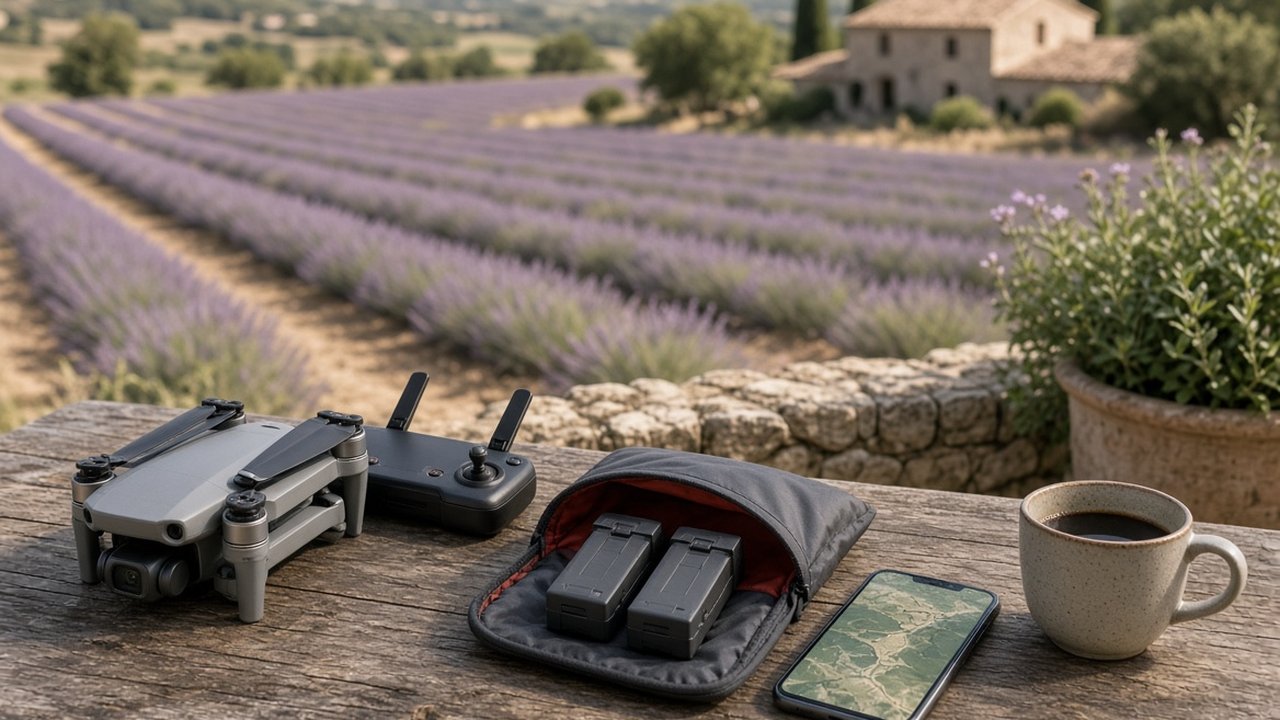
Living outside the EU? Then you register in the first EU country you fly in [2], [4]. If that is France, registration runs through AlphaTango.
Living in France: AlphaTango and online training
If you live in France, you register there as an EU operator. This is done online on DGAC’s AlphaTango portal and, according to the ministry, free of charge [4], [5].
Register as an EU operator on AlphaTango; the operator number starts with FRA [3], [5].
Drones from 800 g or with an electronic signalling device are also registered on AlphaTango; the registration is valid for up to five years [3].
The registration number must be on the drone, otherwise a €750 fine applies [3].
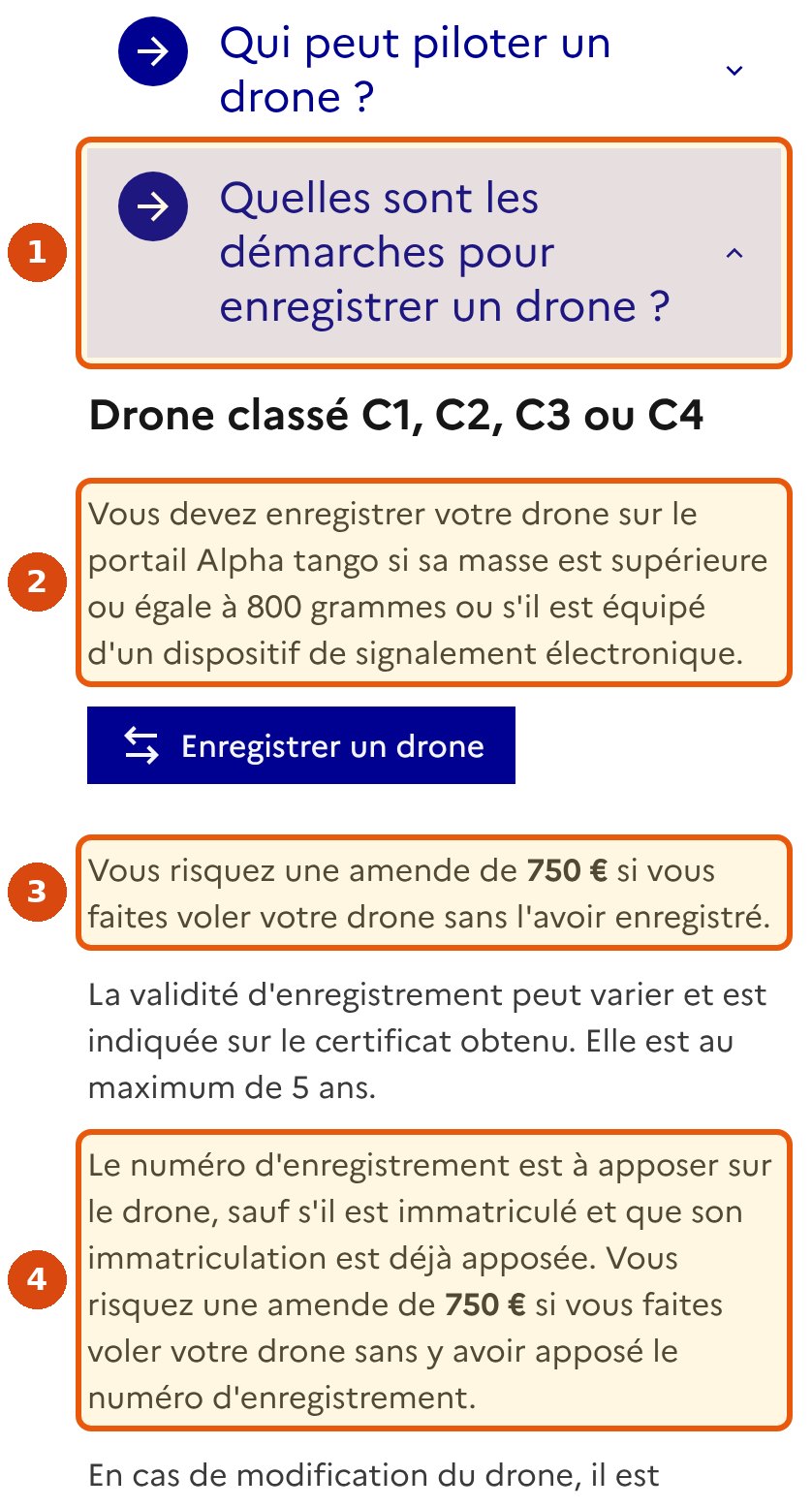
- Section “Quelles sont les démarches pour enregistrer un drone ?”.
- Registration on AlphaTango from 800 g or with an electronic signalling device.
- Flying without registration can cost a €750 fine.
- The registration number must be on the drone, otherwise also €750.
Source: Service Public (Directorate of Legal and Administrative Information, Prime Minister’s office), service-public.gouv.fr · Etalab 2.0 licence · screenshot taken on 17 November 2026 · markings: drohnen.de
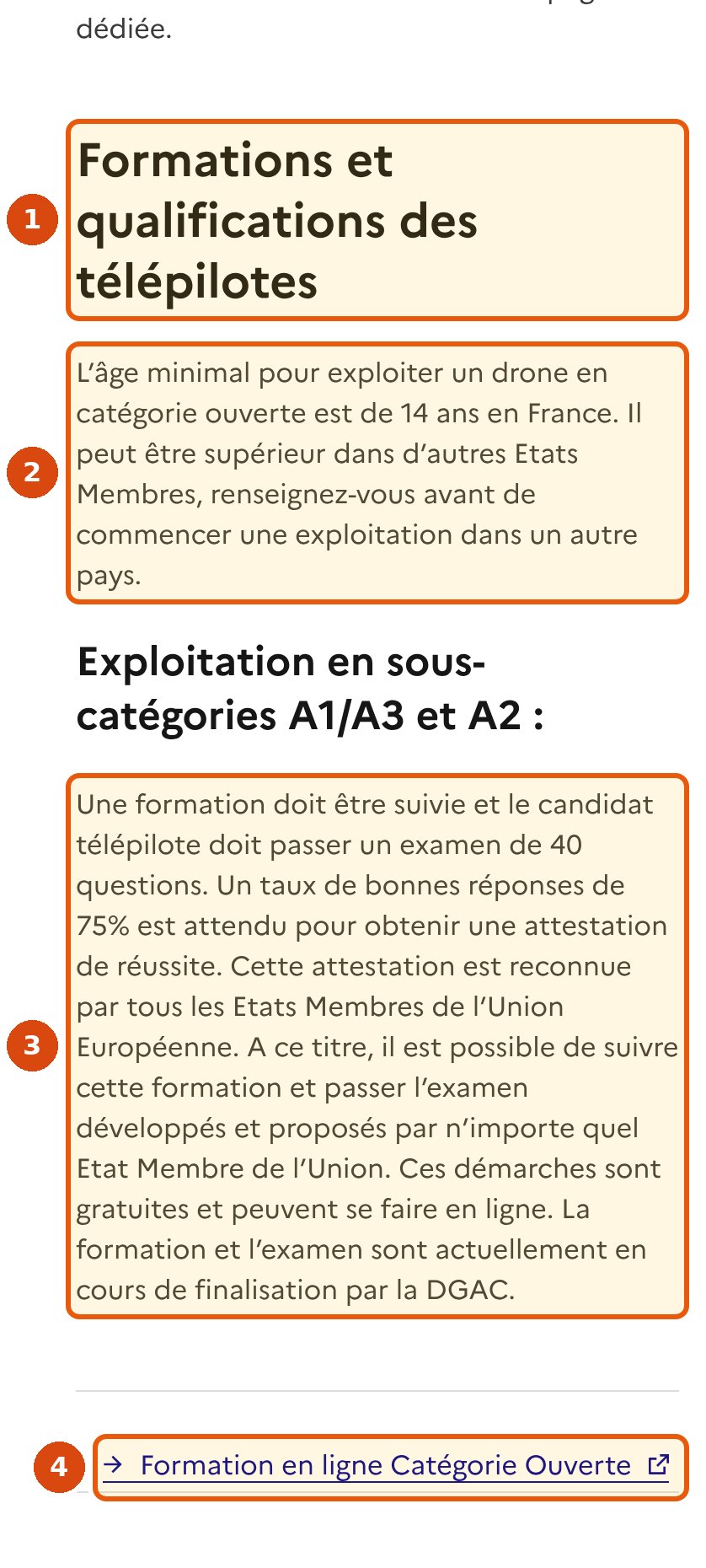
- Section “Formations et qualifications des télépilotes”.
- Minimum age in France: 14.
- Exam with 40 questions, 75 percent correct; free and online according to the ministry.
- Link to the official online training.
Source: Ministry for the Ecological Transition (DGAC), ecologie.gouv.fr · Etalab 2.0 licence · screenshot taken on 17 November 2026 · markings: drohnen.de
Map and no-fly zones
The official map of restrictions for the open category is on cartes.gouv.fr since the Géoportail closed [7]. According to DGAC the map does not show short-term restrictions; these are published by the aeronautical information service SIA [4]. Near aerodromes and military zones the permitted height is in places 50 m instead of 120 m [3].
Flights are prohibited over national parks and nature reserves, hospitals, prisons and industrial sites, among others. In addition there are zones where aerial photography is banned [4].
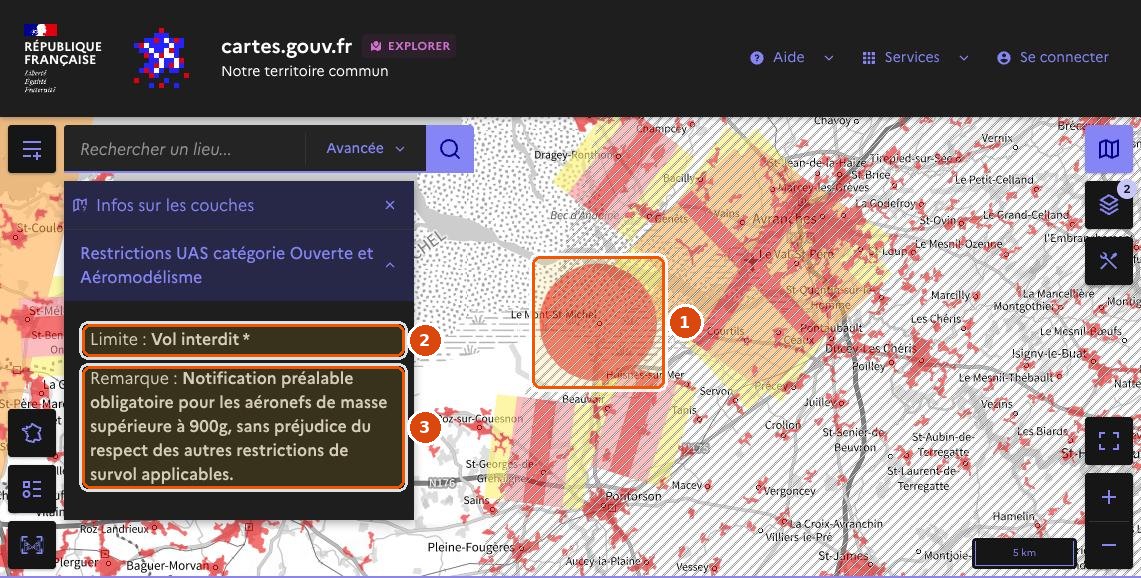
- Red circle around Mont-Saint-Michel.
- For this area the map says “Vol interdit” – flying prohibited.
- Additional map note: prior notification for aircraft over 900 g, without prejudice to other overflight restrictions.
Source: cartes.gouv.fr (IGN), DGAC layer “Restrictions UAS catégorie Ouverte et Aéromodélisme”, base map Plan IGN · screenshot taken on 18 November 2026 · markings: drohnen.de
Towns, Paris and night flying
Flying over public space in built-up areas is prohibited [3]. Over private land in a town it is possible with the owner’s consent, according to DGAC, as long as the drone stays close enough that it cannot drift over public space. In Paris, DGAC says all outdoor flights are prohibited, even over private land [4].
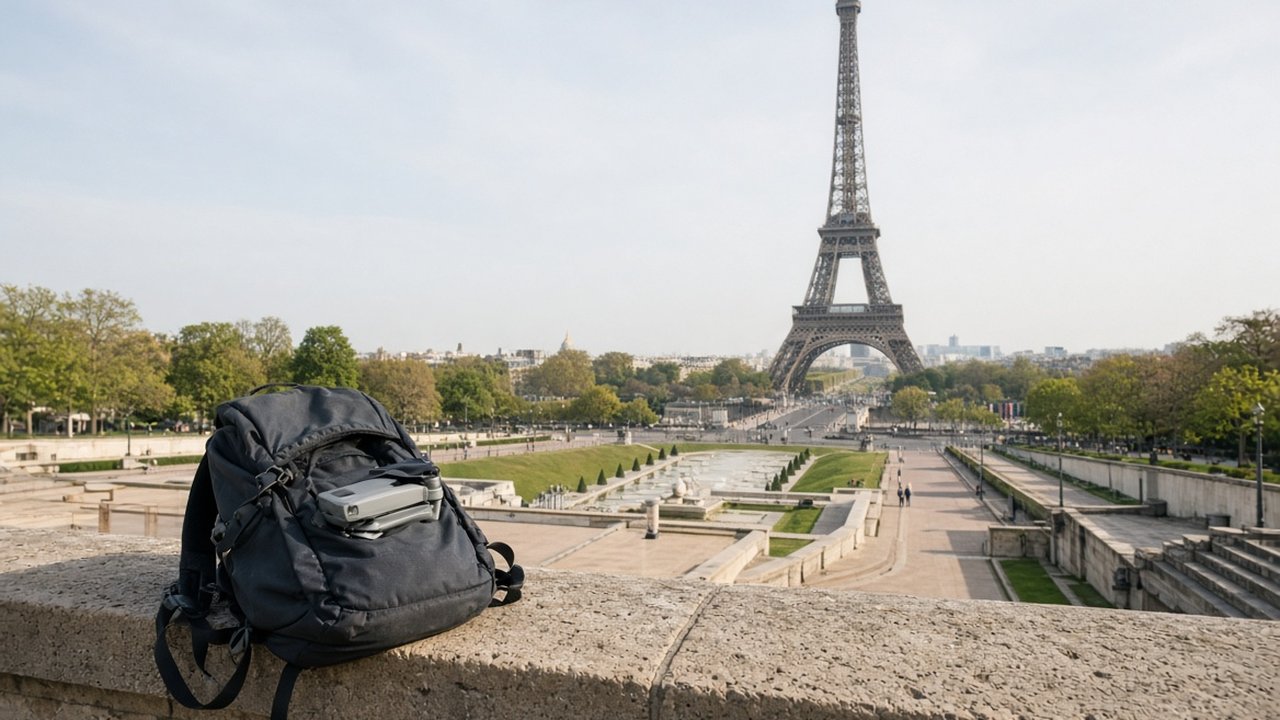
Drones may not fly at night, even with lights; exceptions apply at certain model aircraft club sites [3]. The ministry also mentions exemptions granted by the competent prefect [4].
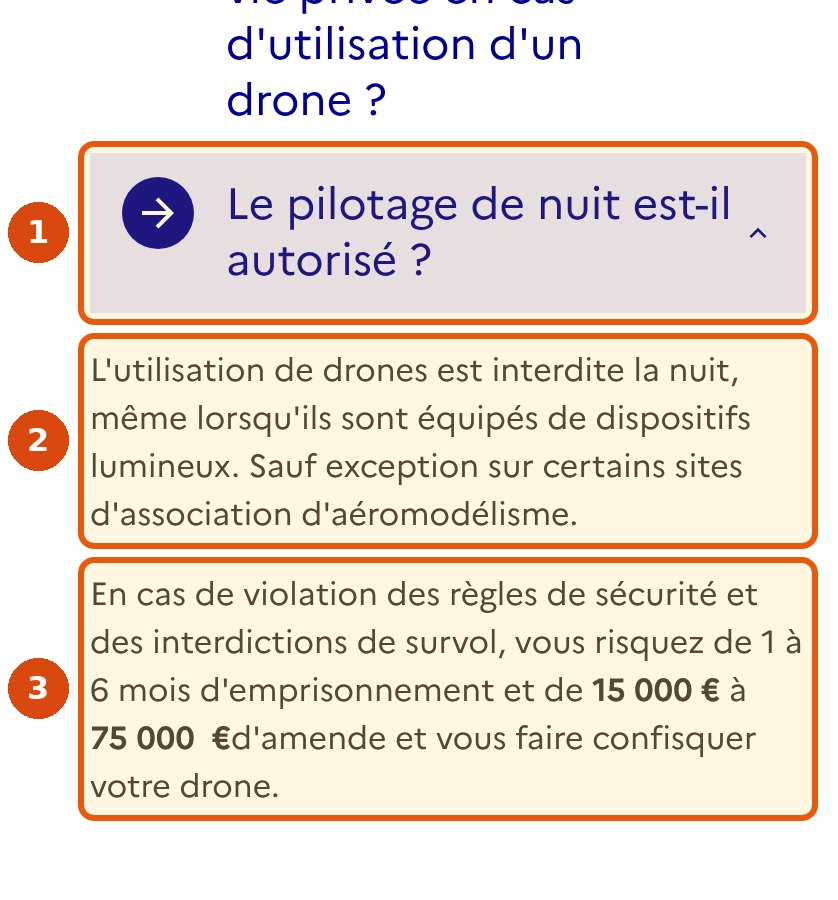
- Section “Le pilotage de nuit est-il autorisé ?”.
- Drones may not fly at night, even with lights; exceptions exist at model aircraft club sites.
- Breaching safety rules and overflight bans can mean 1 to 6 months in prison and fines of €15,000 to €75,000.
Source: Service Public (Directorate of Legal and Administrative Information, Prime Minister’s office), service-public.gouv.fr · Etalab 2.0 licence · screenshot taken on 17 November 2026 · markings: drohnen.de
Privacy, insurance and penalties
If you film people you must inform them; publishing requires their consent. Privacy violations can mean up to one year in prison and a €45,000 fine [3]. Breaching safety rules and overflight bans can lead to 1 to 6 months in prison, fines of €15,000 to €75,000 and confiscation of the drone [3].
France does not require insurance. The operator is, however, strictly liable for damage on the ground [4]. Check whether your existing liability cover includes drones and applies in France.
France sets a minimum age of 14 for the open category instead of the EU default of 16. Younger children may, according to Service Public, fly a C0 toy drone or fly accompanied by a pilot aged 16 or over [3], [4].
Applications, portals and costs at a glance
DGAC portal for registering operators and drones from 800 g.
Free A1/A3 training with an exam of 40 questions.
Official map of restrictions for drones in the open category.
Overview by the French administration portal on registration, height, night flying and penalties.
| What | Where | Cost | For whom |
|---|---|---|---|
| Operator registration | AlphaTango | free | French residents, visitors from outside the EU |
| Registration of drones over 800 g | AlphaTango | free | everyone, including EU visitors |
| A1/A3 training | DGAC online training | free | Residents without an EU certificate |
| Electronic signalling device | Retailers | depends on device | Drones over 800 g |
Sources: Service Public [3], ministry/DGAC [4], [5], [6].
Common mistakes on a trip to France
After sunset flying is prohibited, even with lights [3].
Over public space in built-up areas and outdoors in Paris flying is prohibited [3], [4].
Visitors with drones over 800 g often lack the AlphaTango registration and the French signalling device [4].
France from above: landscapes, highlights and limits
France borders the Atlantic, the Channel and the Mediterranean and stretches from the Alps and Pyrenees across the Massif Central to the lavender fields of Provence. Icons such as Mont-Saint-Michel in its tidal bay are UNESCO World Heritage [9].
National parks protect some of the finest landscapes – and drone flights are banned in their core areas. Other zones are shown on the official map at cartes.gouv.fr [7].
Places worth seeing – and what to check
NormandyMont-Saint-Michel and its bay
A Gothic abbey on a rock among sandbanks that becomes an island at high tide [9].
Drone check: According to the official map, flying is prohibited in the red circle around the Mont (screenshot above); outside it, check the zone and never fly over visitors.
ProvenceVerdon Gorge and lavender fields
Turquoise water between high limestone walls, with lavender and hill villages inland.
Drone check: Check the zone; hill villages count as built-up areas; respect private land.
Côte d’AzurCoast and Calanques near Marseille
Rocky coves with clear water between Marseille and Cassis.
Drone check: The Calanques are a national park: no drone flights in the land or marine core [10].
Alps and PyreneesPeaks, lakes and valleys
High mountains with glaciers, lakes and passes – stunning from above, but often protected.
Drone check: Avoid national park core areas; choose valleys outside the parks.
Where the drone stays on the ground
Recreational drones are banned in the core of the Mercantour National Park [11]. In the Pyrenees National Park, drone flights below 1,000 m above ground are prohibited in the core area, with fines from 135 euros [12].
In the Calanques National Park, flying drones or model aircraft is banned in both the land core and the marine core [10].
Whatever the motif: no night flights and no flights over public space in built-up areas – see the rules above.
Videos: France from above
Channel names, dates and locations are taken from each YouTube page; none of the films has spoken commentary. We cannot verify whether the footage was filmed with permission, and it does not show where you may fly today.
France 4K – Scenic Relaxation Film With Calming Music
According to the channel, from the French Riviera to Mont-Saint-Michel. Music only; locations are not named individually.
The video only loads from YouTube after you click (privacy-enhanced mode). Watch on YouTube
Mont Saint Michel from a drone.
Mont-Saint-Michel during a spring tide that turns it into an island. According to the description, the film won awards at drone film festivals in Cabourg and Nantes in 2015. It was shot long before today’s rules – the official map now shows a flight ban there.
The video only loads from YouTube after you click (privacy-enhanced mode). Watch on YouTube
France 4K – Scenic Relaxation Film With Inspiring Music
A second landscape film from the same channel, from Mont-Saint-Michel to the French Riviera.
The video only loads from YouTube after you click (privacy-enhanced mode). Watch on YouTube
Frequently asked questions about drones in France
Can I bring my drone to France?
Yes. With your home operator registration, a visible operator ID and an EU pilot certificate you may fly in the open category. Over 800 g you also need AlphaTango and a French signalling device.
Can I fly a drone at night in France?
No. Night flying is prohibited, even with lights. Exceptions exist only at certain model aircraft sites and by permission of the prefect.
Can I fly a drone in Paris?
According to DGAC all outdoor flights are prohibited in Paris, even over private land.
Do I have to register in France?
Not as an operator if you are registered in another EU country. If your drone weighs over 800 g, you must register it on AlphaTango.
Where can I see no-fly zones in France?
On the map at cartes.gouv.fr. Short-term restrictions are published by the aeronautical information service SIA.
Is drone insurance mandatory in France?
No, but the operator is strictly liable for damage on the ground.
What is the minimum age for flying a drone in France?
14 in the open category, with exceptions for toy drones and accompanied flights.
Are the rules about to change?
Possibly. In September 2026 EASA proposed registration and Remote ID from 100 g. This has not been adopted yet.
Conclusion: daylight, open country and the 800-gram limit
Visitors from other EU countries can fly in France with their home registration and EU certificate, but must know the French specifics: no night flights, none over public space in towns and practically none in Paris. Anyone bringing a drone over 800 g also needs AlphaTango and a French signalling device.
If you move to France, register for free on AlphaTango and take DGAC’s online training; the minimum age is 14.
Share
Who is flying in France?
Send the checklist to anyone taking a drone to France.
TransparencySources and data12 entries, primary sources first
- EUR-Lex: Implementing Regulation (EU) 2019/947 (legal text), accessed 17 Nov 2026.
- EASA: Travelling with drones (agency), updated 27 Sep 2022.
- Service Public: Drone : règles de pilotage à respecter – drone marqué CE (administration portal), updated 23 Sep 2025.
- Ministère de la Transition écologique / DGAC: Exploitation de drones en catégorie ouverte (authority), updated 3 Sep 2026.
- DGAC: AlphaTango (authority online service), accessed 17 Nov 2026.
- DGAC: Formation en ligne des télépilotes (authority online service), accessed 17 Nov 2026.
- IGN / cartes.gouv.fr: Restrictions UAS catégorie Ouverte et aéromodélisme (map), accessed 17 Nov 2026.
- EASA: Opinion No 06/2026 (agency), 18 Sep 2026, proposal without legal effect.
- UNESCO: Mont-Saint-Michel and its Bay (World Heritage listing), accessed 18 Nov 2026.
- Parc national des Calanques: Bons gestes et réglementation (protected-area management), accessed 18 Nov 2026.
- Parc national du Mercantour: Communiqué : les drones de loisir interdits dans le cœur du parc (PDF) (protected-area management), accessed 18 Nov 2026.
- Parc national des Pyrénées: Communiqué : contrôles interservices drones (PDF) (protected-area management), accessed 18 Nov 2026.
NotesDisclaimer and transparency
Note: This article provides general information on drone law in France. It does not replace legal advice or binding information from DGAC. The legal texts and the current map before each flight are what count. Last editorial review of the legal position: 17 November 2026.
Transparency: This article was researched and written with AI assistance and checked by our editors. All photos are AI-generated illustrations and labelled as such; they do not imply permission to fly at the places shown. Screenshots come from service-public.gouv.fr and ecologie.gouv.fr (Etalab 2.0 licence); the markings were added by us. The Amazon link is an affiliate link: if you buy through it, drohnen.de earns a commission. Your price does not change, and Amazon takes you to your local store.
Uncertainties: The details on Paris, private land in towns and liability come from DGAC’s guide to the open category as summarised by the ministry. The videos are third-party content.
Transparency and editorial note: in line with the transparency requirements of Article 50 of the EU AI Act, which apply since 2 August 2026, our articles are checked, put into context and approved by our editors before publication. Final assessment and editorial responsibility rest with our editorial team.
Besides our own and supplied photos, we use illustrative images. These may be created or edited with digital tools. Where legal transparency or labelling duties apply to individual content, it is marked accordingly.

