You are reading: drone rules for Spain
Drone rules Spain · Updated 2026
Flying a drone in Spain: what visitors and residents need to know in 2026
Spain applies the EU drone regulation like every other member state. On top of that, Royal Decree 517/2024 adds national rules: anyone flying in a town or over a crowd must notify the Ministry of the Interior five days in advance, and fixed protection zones surround airports, ports and hospitals. This guide explains what you need as a visitor from another EU country or from outside the EU, what applies if you live in Spain, and where to apply for what.
- EU registration valid in Spain
- Urban flights: notify 5 days ahead
- Map: ENAIRE Drones
I am visiting Spain I live in Spain
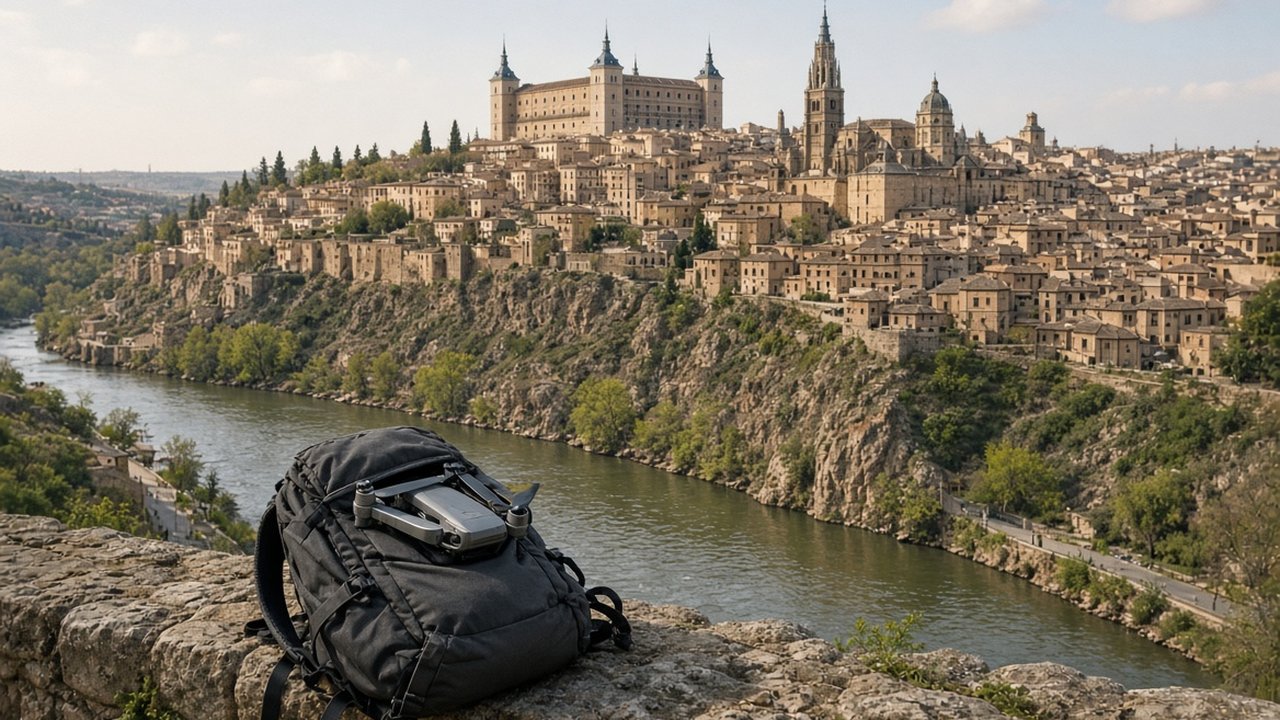
AI-generated image
Status: legal position in 2026, based on Regulation (EU) 2019/947, the consolidated Spanish Royal Decree 517/2024 and the websites of the Spanish aviation safety agency AESA and the Ministry of the Interior. This is editorial guidance, not legal advice.
On 18 September 2026, EASA recommended in Opinion 06/2026 that registration and Remote ID should start at 100 instead of 250 grams [14]. This is not law yet. If adopted, it would apply in every EU country, including Spain.
The key points in 20 seconds
If you are registered as a drone operator in your EU country of residence, you do not register again in Spain. Your operator ID must be visible on the drone [2], [4].
A1/A3 proof of training and the A2 certificate from any EASA member state are recognised in Spain [2].
Operators who must register have to notify the Ministry of the Interior at least five days before flying in an urban area or over a crowd [3], [9].
In the open category, buildings, homes and their gardens are off limits unless the owner agrees [3].
Airport zones, protected areas and restricted zones are shown in the free ENAIRE Drones web app and mobile app [8], [10].
Spain exempts A1 and A3 flights with drones under 20 kg from mandatory insurance, but not A2. Liability cover is still strongly recommended [3].
EU law and Spanish rules: what applies where?
Since 2021, the same basic drone rules have applied across the EU: Implementing Regulation (EU) 2019/947 with the open, specific and certified categories, the A1, A2 and A3 subcategories and mandatory operator registration [1]. You register in the country where you live, and that registration is valid in all EASA member states. Pilot certificates are recognised everywhere too [2].
The regulation leaves room for national rules. Article 15 lets countries define geographic zones where flights are banned, restricted or subject to conditions [1]. Spain did so with Royal Decree 517/2024, in force since 25 June 2024 [3], [8]. It covers urban flights, protection zones around infrastructure, insurance and the minimum age.
| Topic | Rule in Spain | Legal basis |
|---|---|---|
| Registration | In your country of residence, from 250 g or with a camera (toys excepted); ID visible on the drone | EU 2019/947, AESA |
| Pilot competence | A1/A3 online, A2 with an extra exam; valid EU-wide | EU 2019/947 |
| Height | Maximum 120 m in the open category | EU 2019/947 |
| Urban flights | Notify the Ministry of the Interior at least 5 days ahead | RD 517/2024, Art. 40 |
| Buildings | No overflight of buildings or homes without the owner’s consent | RD 517/2024, Art. 40 |
| Critical infrastructure | Protection zone 10 to 25 m sideways and 50 m above; operator’s permission needed | RD 517/2024, Art. 39 |
| Aerodromes | Zones of about 6 × 5 km to 10 × 7.5 km; flights only after coordination | RD 517/2024, Art. 41 |
| Insurance | Mandatory for A2; A1 and A3 under 20 kg exempt | RD 517/2024, Art. 8 |
| Minimum age | 16 in principle; from 12 or 14 depending on subcategory and class | RD 517/2024, Arts. 6 and 7 |
Sources: Regulation (EU) 2019/947 [1], consolidated Royal Decree 517/2024 [3], AESA [4], [5].
VisitorYou live in another country and fly on holiday
Your home registration and EU certificate are enough if you live in the EU. Visitors from outside the EU register in the first EU country they fly in.
ResidentYou live in Spain
Then you are a Spanish operator: register with AESA and keep any EU certificate you already hold.
Visiting Spain with a drone: your checklist
For open-category flights you do not need extra permission from AESA. The agency points operators from other EU states to their home rules and to the restrictions of the country they visit [11]. What matters are Spain’s zones and special rules.
Drones from 250 g or with a camera need an operator ID. A registration from your EU country of residence stays valid in Spain; registering in two countries is not possible [2], [4].
Carry your A1/A3 proof of training or A2 certificate on paper and on your phone. Both are valid EU-wide [2].
Check whether your liability cover applies abroad. Spain requires insurance for flights in A2 [3].
Open ENAIRE Drones before every take-off: airports, military areas, protected areas and temporary restrictions [8], [10].
Flying in a town, on an urban beach or over people requires a notice to the Ministry of the Interior five days ahead [9].
Your operator number must be visible on every drone. One option is a 20 × 8 mm aluminium plate, laser-engraved with your operator number without the three secret characters. According to the seller it is made for light drones such as the DJI Mini series or Neo.

Living outside the EU? Then you register in the first EU country you fly in. If that is Spain, you can do it online with AESA without a Spanish ID: foreign nationals identify themselves through the e4F system and then sign in with a key and their passport number [2], [4]. AESA offers the A1/A3 online training free of charge [6]. UK residents are included: since Brexit the United Kingdom is not an EASA member state.
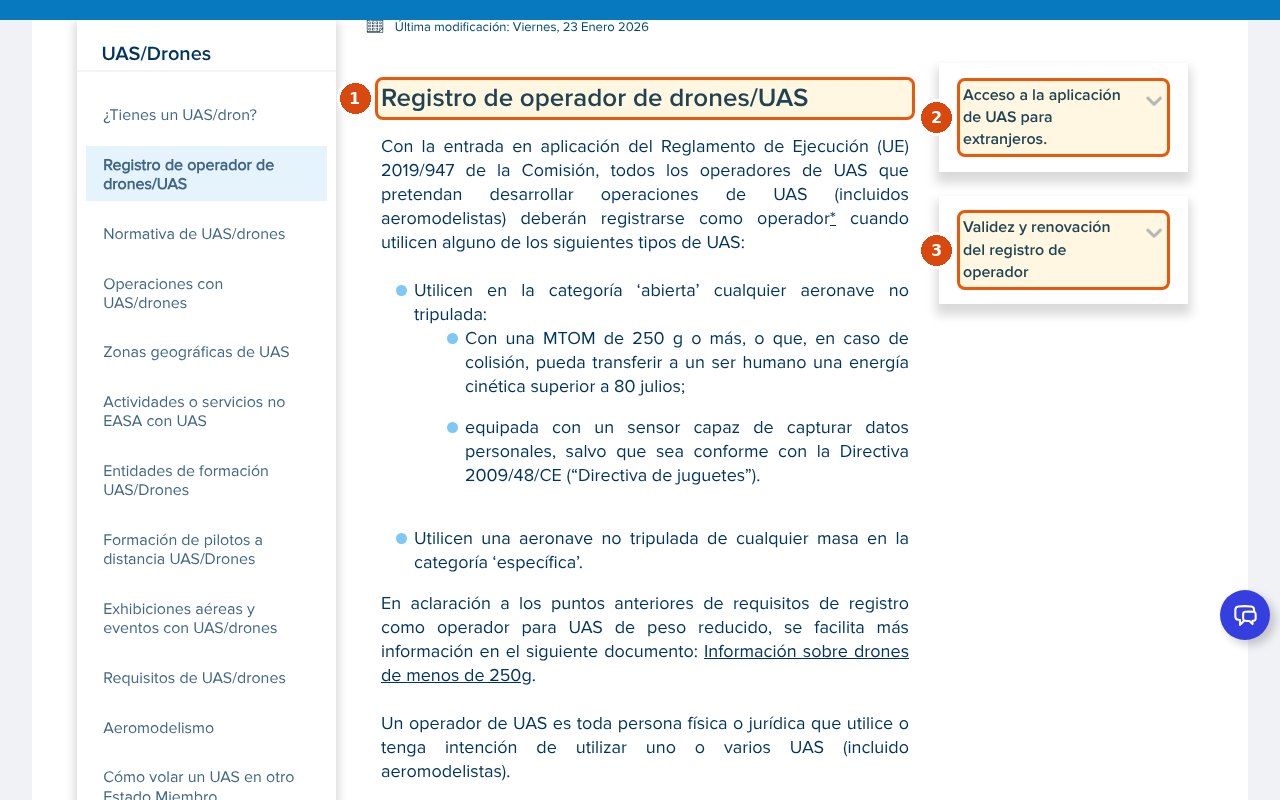
- Page “Registro de operador de drones/UAS” of the Spanish Aviation Safety Agency.
- “Acceso a la aplicación de UAS para extranjeros”: access for foreign nationals without a Spanish ID number.
- “Validez y renovación”: validity and renewal of the registration.
Source: AESA (Spanish Aviation Safety Agency), seguridadaerea.gob.es · screenshot taken on 17 November 2026 · markings: drohnen.de
Living in Spain: registering with AESA
If you move to Spain or live there permanently, you register in Spain. Registration happens in your country of residence, and being registered in several states at once is not possible [4]. People who spend only the winter in Spain and keep their main residence elsewhere stay registered at home, in our reading of the residence rule.
Open an account in the UAS application of the AESA e-office. You then have 90 days to complete the operator registration, otherwise the account is deleted [4].
With a digital certificate the registration is completed immediately. Without a Spanish certificate, use e4F with your passport [4].
Put the new operator number visibly on every drone. If the drone is too small, the battery compartment is allowed [5].
AESA offers the course and exam online for free: 40 questions, 40 minutes, at least 75 % correct, valid for five years [6].
Registrations issued since 25 June 2024 are valid for three years; older ones expire on 25 June 2027. Any change to the record extends validity by three years [4].
Registration is free [4]. A certificate you already earned in another EU country stays valid [2].
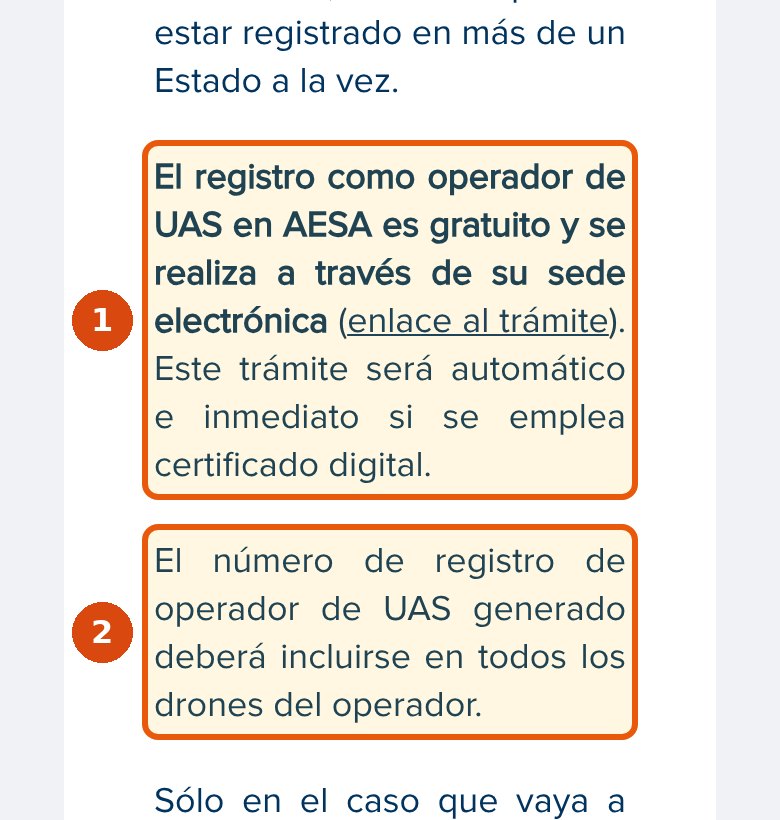
- Registration with AESA is free and done through its e-office (sede electrónica). With a digital certificate it is immediate.
- The registration number must be shown on all of the operator’s drones.
Source: AESA (Spanish Aviation Safety Agency), seguridadaerea.gob.es · screenshot taken on 17 November 2026 · markings: drohnen.de
Geographic zones: the ENAIRE Drones map
Where you may fly is shown by the Spanish air navigation provider ENAIRE in the free ENAIRE Drones app, on the web at drones.enaire.es and for Android and iOS [8], [10]. It brings together the UAS geographic zones under Royal Decree 517/2024: aerodrome zones, control zones, military and security areas, environmental protection areas and zones where photography is restricted [3], [7].
In controlled airspace, flights outside aerodrome zones within visual line of sight up to 60 m are allowed without coordination [3], [8]. If you need coordination with an airport or air navigation operator, they have one month to reply; standard procedures need 72 hours’ notice [3]. On holiday the practical advice is simple: stay away from airport zones.

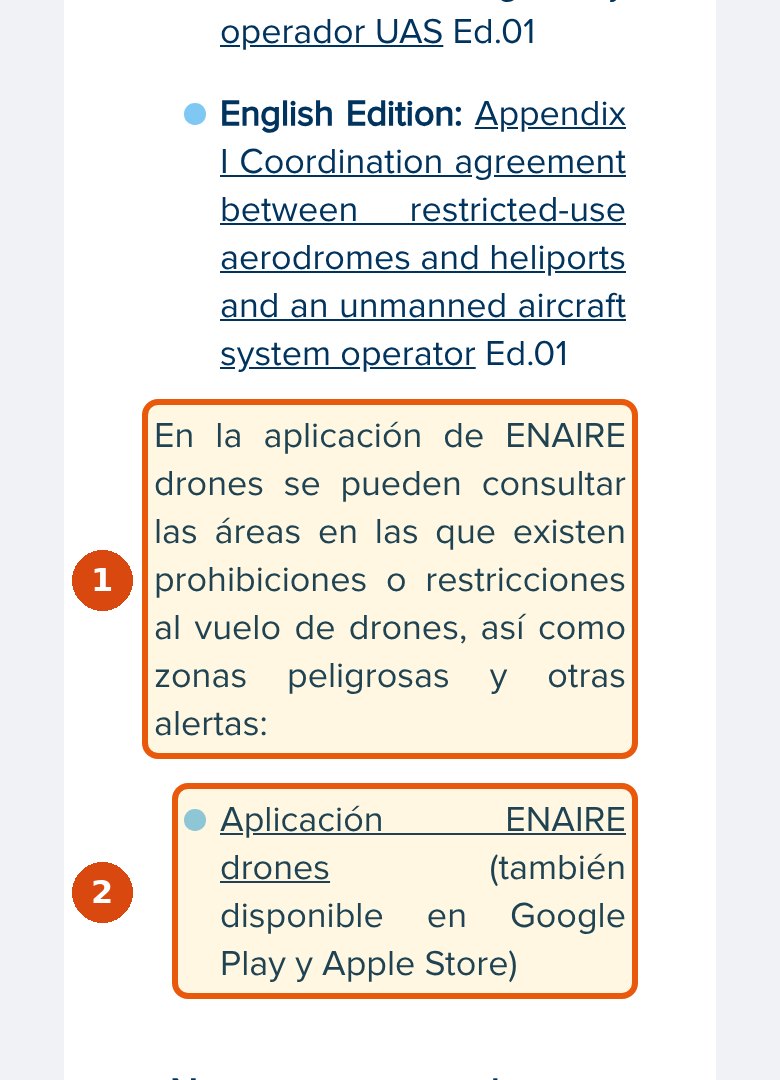
- The ENAIRE Drones app shows prohibited and restricted areas, dangerous zones and other alerts.
- The link to the app, also available for Android and iOS.
Source: AESA (Spanish Aviation Safety Agency), seguridadaerea.gob.es · screenshot taken on 17 November 2026 · markings: drohnen.de
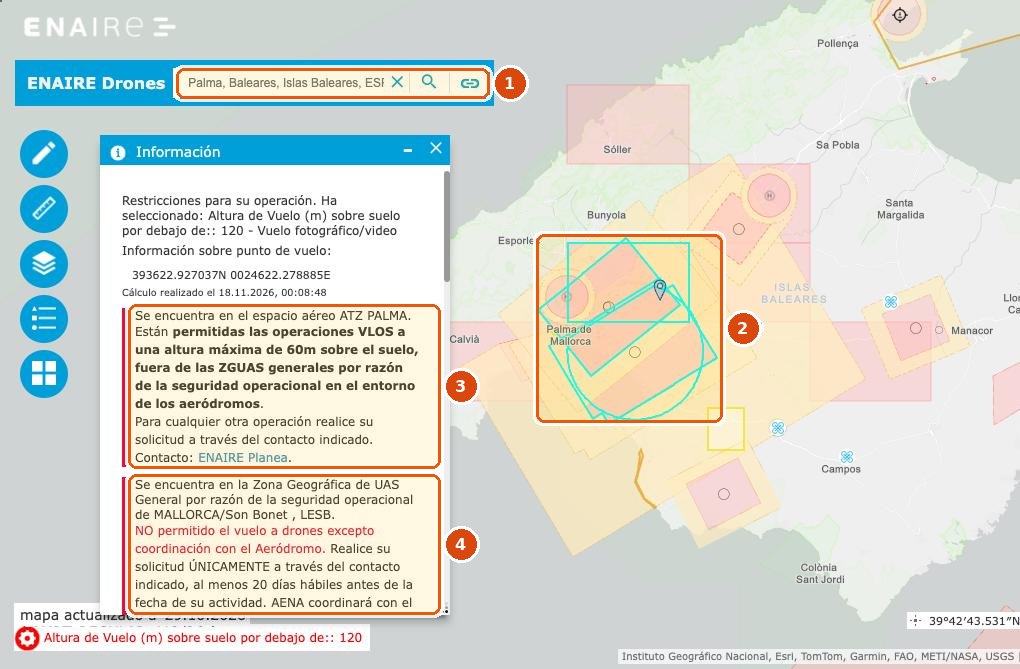
- Enter a place, here Palma.
- Tap your planned take-off point; the map lists every zone that applies there.
- At this point near Palma: ATZ Palma airspace, VLOS flights up to 60 m above ground allowed outside the general geographic zones.
- Geographic zone of Son Bonet aerodrome: drones only after coordination with the aerodrome, request at least 20 working days ahead.
Source: ENAIRE, drones.enaire.es (base map incl. Instituto Geográfico Nacional, Esri) · screenshot taken on 18 November 2026 · markings: drohnen.de
Towns, urban beaches and crowds: the notice duty
Spain’s most important special rule is Article 40 of Royal Decree 517/2024. Urban areas include built-up settlements, residential, commercial and industrial areas and public recreational spaces. The zone extends up to 300 m above the highest obstacle within 600 m [3].
Operators who are required to register, which covers almost every camera drone, must notify the Ministry of the Interior at least five days before flying in such areas or over crowds. One notice can cover several flights within five days, with the date and time window for each. The security authorities can restrict or prohibit flights [3], [9].
The notice is filed through the Ministry’s e-office. People who are not obliged to deal with the administration electronically can hand in the PDF form at a public registry office or, from abroad, at a Spanish consulate [9]. Regardless of the notice, do not fly over buildings, homes or gardens without the owner’s consent. With a C1 drone from 250 g keep 5 m horizontal distance from buildings, with C2 30 m, or 5 m in low-speed mode [3].
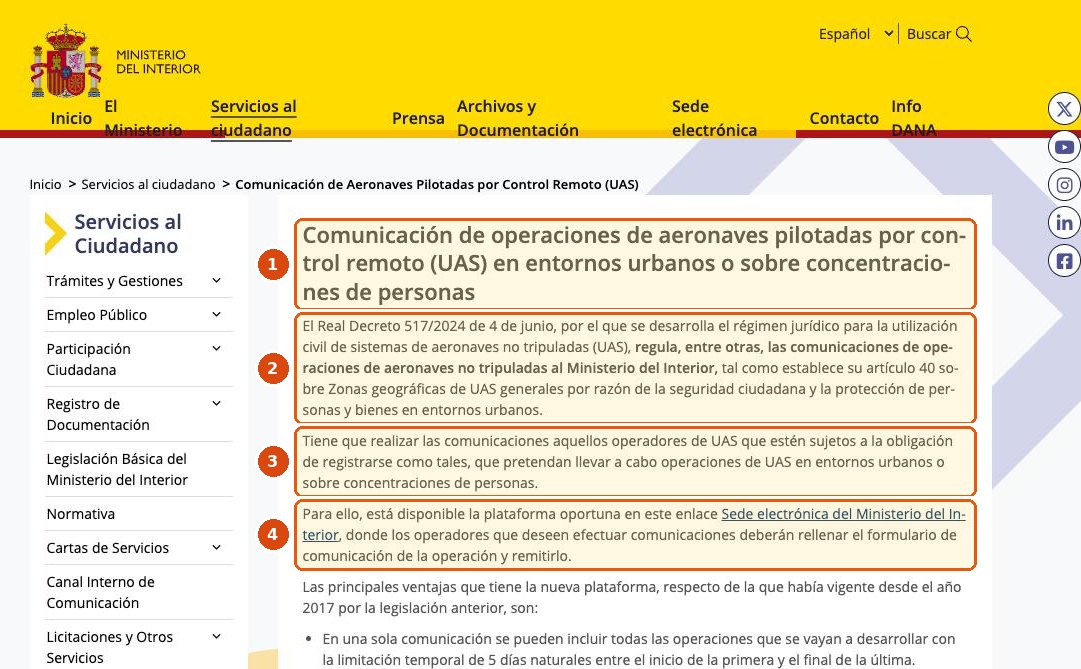
- Page on notifying UAS operations in urban areas or over assemblies of people.
- Legal basis: Article 40 of Royal Decree 517/2024.
- Operators who must register and plan flights in towns or over crowds have to notify.
- Link to the e-office with the notification form.
Source: Ministerio del Interior, interior.gob.es · screenshot taken on 18 November 2026 · markings: drohnen.de
On 19 June 2025 Spain’s Supreme Court annulled Articles 53 to 58 of Royal Decree 517/2024, i.e. the planned drone register at the Ministry of the Interior with its sale and transfer reporting duties [12], [13]. The urban flight notice under Article 40 is not affected.
Airports, ports, hospitals and nature
Zones of about 6 × 5 km to 10 × 7.5 km surround public aerodromes. Flying there is prohibited unless coordinated with the operator [3].
Power plants, ports, rail and road infrastructure, utility networks, hospitals and police barracks: protection zone of 25 m (linear) or 10 m (other sites) sideways and 50 m above; only with the operator’s permission [3], [8].
Environmental protection zones such as national parks have restrictions; flights require prior coordination with the area’s managers [3], [8].
Defence and security facilities are prohibited zones. Flying requires express permission [3].
Insurance and minimum age
Under Article 8 of Royal Decree 517/2024, drones from 20 kg need insurance under Regulation (EC) 785/2004. Below that, liability insurance is mandatory for subcategory A2 and for the specific and certified categories. A1 and A3 flights with drones under 20 kg are exempt from the Spanish insurance requirement [3]. A crash onto a car or a person can still be expensive, so check that your liability policy covers drone flights in Spain.
The minimum age for remote pilots in the open category is 16 in principle. Spain lowers it: 12 for A1 with a C0 drone that is not a toy, and 14 in some A2 and A3 cases. Operators must be 16 [3]. These ages apply to flights in Spain, including for visiting families.
Applications, portals and costs at a glance
Map of all UAS geographic zones in Spain with warnings and NOTAMs. Check it before every flight.
Notice of flights in towns or over people, at least 5 days ahead, covering up to 5 days.
For residents of Spain and visitors from outside the EU flying first in Spain. Foreign nationals without a Spanish ID use e4F.
Official online course and exam with 40 questions. A2 is an additional supervised exam.
| What | Where | Cost | Who |
|---|---|---|---|
| Operator registration | AESA e-office (UAS application) | free | Residents of Spain, non-EU visitors |
| A1/A3 certificate | AESA e-office, online | free | anyone without an EU certificate |
| A2 certificate | AESA e-office, supervised exam | not stated on the AESA page | pilots with A1/A3 |
| Urban flight notice | Ministry of the Interior e-office or form | free | operators required to register |
| Aerodrome coordination | Aerodrome or air navigation operator | not stated | flights near aerodromes |
Sources: AESA [4], [6], Ministry of the Interior [9], Royal Decree 517/2024 [3]. Costs as stated on the authorities’ websites (2026).
Common mistakes on a trip to Spain
Urban beaches and promenades usually count as urban areas. Without a notice five days ahead, the flight is not allowed [3], [9].
Hotels, holiday homes and their gardens are buildings and private areas. Without the owner’s consent, overflight is prohibited [3].
Ports are critical infrastructure with a fixed protection zone. Without the operator’s permission, the drone stays on the ground [3].
If you live in another EU country, do not register again in Spain. Registration in several states is not possible [4].
Spain from above: landscapes, highlights and limits
Spain is far more than beaches. The mainland combines the high plateau of the Meseta, the Pyrenees in the north and the Sierra Nevada in the south, while the Balearic Islands lie in the Mediterranean and the Canary Islands off the coast of Africa. Tenerife’s Teide, a volcano and Spain’s highest peak, stands in a national park that is a UNESCO World Heritage Site [15].
The most spectacular landscapes are often protected. Spain’s national parks range from Ordesa y Monte Perdido and the Picos de Europa to Doñana and to Teide, Timanfaya and Garajonay in the Canaries [16]. Filming there usually needs permission from the park management – see below.
Places worth seeing – and what to check
Canary IslandsVolcanic scenery and cliffs
Lava fields, ravines and black-sand beaches make the islands a dream for aerial photos. The best-known volcanic areas, Teide and Timanfaya, are national parks.
Drone check: Fly outside the parks and away from island airports; check the zone in ENAIRE Drones.
AndalusiaGranada and the Alhambra
The Alhambra, Generalife and Albayzín sit on two hills above Granada and form a UNESCO World Heritage Site [17].
Drone check: Urban area: notify the Ministry of the Interior five days ahead; no flights over buildings or crowds.
The northPyrenees and Picos de Europa
High mountains, gorges and green valleys contrast with the coast. Ordesa y Monte Perdido and the Picos de Europa are national parks.
Drone check: Choose valleys and passes outside park boundaries and check protected areas first.
Balearic IslandsCoves and cliffs on Mallorca
Turquoise coves and the mountainous north-west coast attract drone pilots, but beaches and viewpoints are packed in summer.
Drone check: Never over swimmers, notify urban beaches, respect the airport zones around Palma.
Where the drone stays on the ground
In most Spanish protected areas recreational drone flights are prohibited; overflight requires prior permission from the area’s managing body, which is granted mainly for scientific, educational or professional purposes [18].
Filming in the Canary Islands’ national parks requires written permission from the managing administration; using a drone also means declaring the AESA requirements and lodging a higher guarantee [19].
ENAIRE Drones mainly shows airspace zones. Some protected areas appear only as information zones, with an explicit note that this is neither a ban nor a permission and that the area’s management is responsible [10]. The air navigation provider itself reminds pilots to coordinate with the managers of natural areas [20].
In Natura 2000 bird protection areas, drone flights are to be regulated because of collision and disturbance risks; depending on the region you need permission from the environmental authority [18].
Videos: Spain from above
Channel names, dates and locations are taken from each YouTube page; for the AESA video we reviewed the transcript. We cannot verify whether the footage was filmed with permission, and it does not show where you may fly today.
Spain 4K – Scenic Relaxation Film With Calming Music
According to the channel, a journey through Spain’s regions, from Mediterranean views on Ibiza to the mountains of the Picos de Europa. Music only, no narration; individual locations are not named.
The video only loads from YouTube after you click (privacy-enhanced mode). Watch on YouTube
4K DRONE FILM: Mallorca & Canary Islands (+Spa Music) 1HOUR Nature Relaxation™ Aerial Ambient Film
According to the location list in the description: on Mallorca Cap de Formentor, Sa Calobra with the Torrent de Pareis, Port de Sóller, Deià and Sa Foradada; on Fuerteventura the Corralejo dunes, Cofete, the Ajuy caves and Punta Jandía. Of the Canary Islands, only Fuerteventura appears.
The video only loads from YouTube after you click (privacy-enhanced mode). Watch on YouTube
Gran Canaria 4K | Drone | Canary Islands
Shot with a DJI Mavic Pro, according to the description: Playa de Guayedra, Roque Prieto, Barrio San Juan, Las Palmas, Maspalomas, Puerto de Mogán and Roque Nublo. Filmed in 2019, before today’s EU rules applied.
The video only loads from YouTube after you click (privacy-enhanced mode). Watch on YouTube
Cómo registrarse como operador de drones
The authority’s guide (transcript reviewed): anyone established in Spain flying a drone of 250 g or more, or with a camera, must register. AESA recommends a digital certificate, which makes registration instant; without one, identity is checked manually and the signed form is handed in at a registry office. Not needed if you are registered in another EU country.
The video only loads from YouTube after you click (privacy-enhanced mode). Watch on YouTube
Frequently asked questions about drones in Spain
Can I bring my drone to Spain?
Yes. Spain applies the EU drone regulation. With a valid operator registration, a visible operator ID and an EU pilot certificate you may fly in the open category, provided you respect Spanish geographic zones and special rules.
Do I need to register in Spain as a tourist?
Not if you live in another EU country: registration happens in your country of residence and is valid EU-wide. If you live outside the EU and Spain is the first EU country you fly in, you register with AESA.
Is my EU drone licence valid in Spain?
Yes. A1/A3 proof of training and the A2 certificate from any EASA member state are recognised in Spain.
Do I need drone insurance in Spain?
For A2 flights, yes. A1 and A3 flights with drones under 20 kg are exempt from the Spanish insurance requirement. Liability cover is still recommended.
Can I fly my drone on the beach in Spain?
Never over people or crowds. If the beach is in an urban area, operators required to register must notify the Ministry of the Interior five days in advance. Check ENAIRE Drones first.
Where can I see no-fly zones in Spain?
In the free ENAIRE Drones app from the Spanish air navigation provider, on the web at drones.enaire.es or on your phone.
How do I notify an urban drone flight?
Through the Ministry of the Interior’s e-office at least five days ahead. One notice can cover several flights within five days. A PDF form can also be handed in at registry offices or Spanish consulates.
Do the same rules apply in Mallorca and the Canary Islands?
Yes. Royal Decree 517/2024 applies throughout Spain, including the Balearic and Canary Islands. Geographic zones differ by location, for example around island airports.
What is the minimum age to fly a drone in Spain?
16 in principle. Spain allows pilots from 12 in A1 with a C0 drone that is not a toy, and from 14 in some A2 and A3 cases.
Are the rules about to change?
Possibly. In September 2026 EASA proposed registration and Remote ID from 100 g. This has not been adopted yet.
Conclusion: EU paperwork is enough, Spanish zones decide
For visitors from other EU countries, the paperwork is straightforward: your home registration, a visible operator ID and an EU pilot certificate are enough. The real work happens on the ground. Flying in a town, on an urban beach or over people requires a notice to the Ministry of the Interior five days ahead, and buildings, resorts, ports and airport zones are off limits without consent.
The safest approach is to fly mainly in open countryside and open ENAIRE Drones before every flight. If you move to Spain, AESA becomes your authority: registration and the A1/A3 certificate are free.
Share
Who is flying in Spain?
Send the checklist to anyone taking a drone on holiday.
TransparencySources and data20 entries, primary sources first
- EUR-Lex: Implementing Regulation (EU) 2019/947 (legal text), accessed 17 Nov 2026.
- EASA: Travelling with drones (agency), updated 27 Sep 2022.
- BOE: Royal Decree 517/2024, consolidated text (legal text, Spanish), accessed 17 Nov 2026.
- AESA: Registro de operador de drones/UAS (authority, Spanish), accessed 17 Nov 2026.
- AESA: Operaciones con UAS – categoría abierta (authority, Spanish), accessed 17 Nov 2026.
- AESA: Formación de pilotos UAS en categoría abierta (authority, Spanish), updated 9 Feb 2026.
- AESA: Zonas geográficas de UAS (authority, Spanish), updated 7 Aug 2025.
- AESA: Main new features of Royal Decree 517/2024 for geographic zones (authority), 7 Aug 2024.
- Ministry of the Interior: Comunicación de operaciones de UAS en entornos urbanos (authority, Spanish), accessed 17 Nov 2026.
- ENAIRE: ENAIRE Drones (air navigation provider, map application), accessed 17 Nov 2026.
- AESA: Cómo volar un UAS en otro Estado miembro (authority, Spanish), accessed 17 Nov 2026.
- BOE: Supreme Court judgment of 19 June 2025 on Royal Decree 517/2024 (official gazette, Spanish).
- Vozpópuli: El Supremo tumba el registro obligatorio de drones (news report, Spanish), 15 Jul 2025.
- EASA: Opinion No 06/2026 (agency), 18 Sep 2026, proposal without legal effect.
- UNESCO: Teide National Park (World Heritage listing), accessed 18 Nov 2026.
- MITECO: Red de Parques Nacionales (authority), accessed 18 Nov 2026.
- UNESCO: Alhambra, Generalife and Albayzín, Granada (World Heritage listing), accessed 18 Nov 2026.
- Gobierno de Aragón: Vuelo de drones en espacios naturales protegidos (authority), accessed 18 Nov 2026.
- Cabildo de Tenerife / Tenerife Film Commission: Instrucciones para actividades audiovisuales en los parques nacionales de Canarias (PDF) (protected-area management), accessed 18 Nov 2026.
- ENAIRE: Zonas geográficas de ENAIRE (authority), accessed 18 Nov 2026.
NotesDisclaimer and transparency
Note: This article provides general information on drone law in Spain. It does not replace legal advice or binding information from AESA, the Ministry of the Interior or ENAIRE. The legal texts and the current map before each flight are what count. Last editorial review of the legal position: 17 November 2026.
Transparency: This article was researched and written with AI assistance and checked by our editors. All photos are AI-generated illustrations and labelled as such; they do not imply permission to fly at the places shown. Screenshots come from the authority websites named. The Amazon link is an affiliate link: if you buy through it, drohnen.de earns a commission. Your price does not change, and Amazon takes you to your local store.
Uncertainties: Whether seasonal residents stay registered in their home country is our reading of the EU residence rule. AESA does not state the cost of the A2 certificate on its page. The videos are third-party content.
Transparency and editorial note: in line with the transparency requirements of Article 50 of the EU AI Act, which apply since 2 August 2026, our articles are checked, put into context and approved by our editors before publication. Final assessment and editorial responsibility rest with our editorial team.
Besides our own and supplied photos, we use illustrative images. These may be created or edited with digital tools. Where legal transparency or labelling duties apply to individual content, it is marked accordingly.

