You are reading: drone rules for Germany
Drone rules Germany · Updated 2026
Flying a drone in Germany: what visitors need to know in 2026
Germany applies the EU drone regulation, so your registration and pilot certificate from another EU country are valid here. But Germany adds a long list of national no-go areas – from 100 metres around federal roads, railways and industrial sites to residential gardens, nature reserves and national parks – and every drone must be covered by liability insurance. This guide explains what you need before the trip, how to read the official dipul map and where you may realistically fly.
- EU registration valid in Germany
- Liability insurance mandatory
- Map: dipul
Visitor checklist Where you may fly
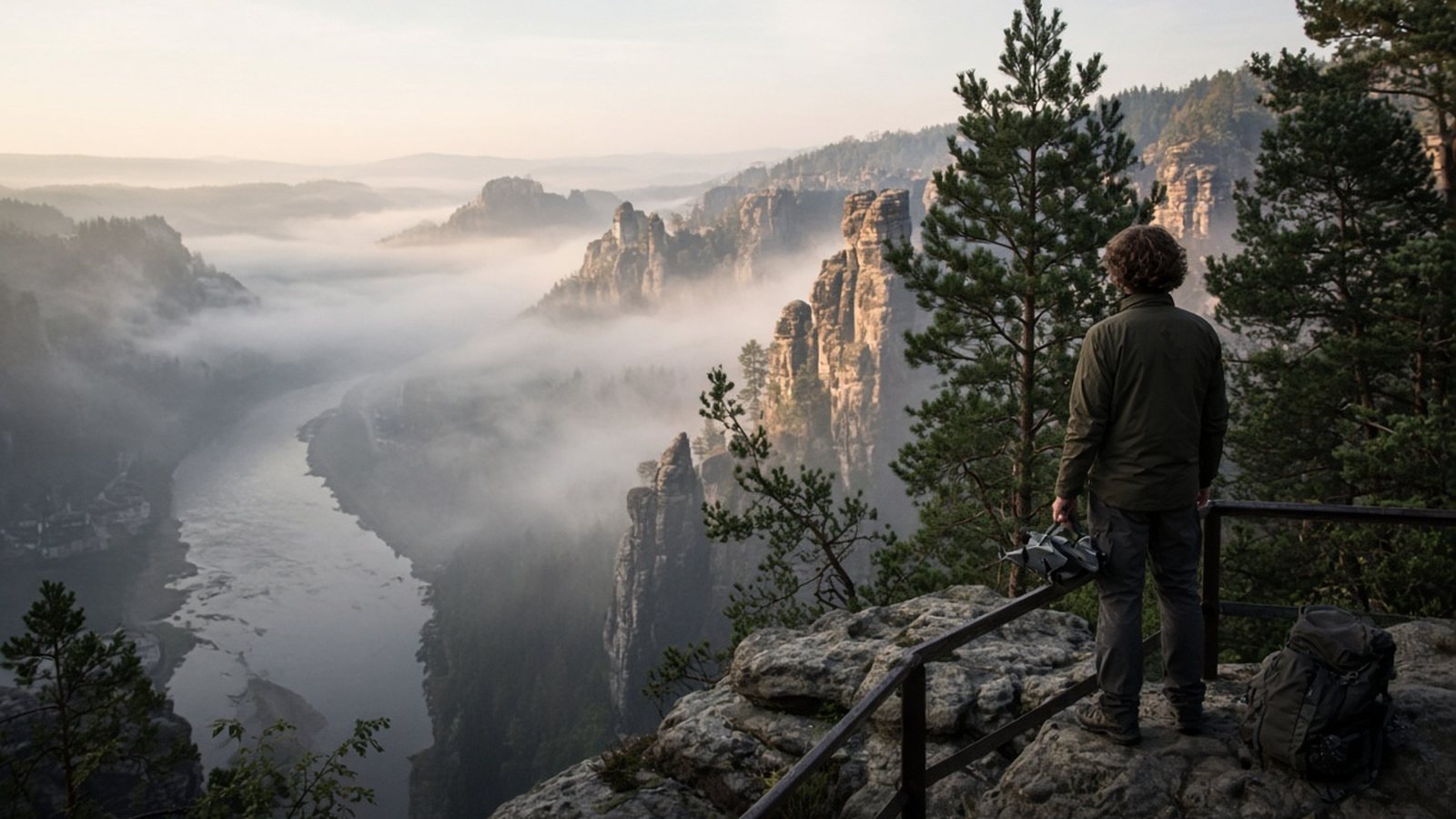
AI-generated image
Status: legal position in 2026, based on Regulation (EU) 2019/947, the German Air Traffic Regulation (LuftVO), the Aviation Act (LuftVG) and the websites of the Federal Aviation Office (LBA) and dipul. This is editorial guidance, not legal advice.
On 18 September 2026, EASA recommended in Opinion 06/2026 that registration and Remote ID should start at 100 instead of 250 grams [10]. This is not law yet. If adopted, it would apply in every EU country, including Germany.
The key points in 20 seconds
If you are registered as an operator in your EU country of residence, you do not register again in Germany. The operator ID must be on the drone [2], [5].
A1/A3 proof of training and the A2 certificate from any EASA member state are recognised in Germany. Carry them on paper or on your phone [2], [6].
German law requires the keeper of every aircraft – drones included – to hold liability insurance [4].
Federal roads, federal waterways and railways have a 100-metre zone; industrial sites, prisons, power plants and government buildings too [3].
Residential properties, nature reserves and national parks are off limits without consent or approval; bathing beaches only outside opening hours [3].
EU law and German rules: what applies where?
Since 2021 the same basic rules have applied across the EU: Implementing Regulation (EU) 2019/947 with the open, specific and certified categories, the A1, A2 and A3 subcategories and mandatory operator registration [1]. You register in the country where you live; that registration and your pilot certificate are valid in all EASA member states [2].
Article 15 of the regulation lets each country define geographic zones. Germany did so in § 21h of the Air Traffic Regulation (LuftVO), one of the most detailed lists in Europe. Most zones are not total bans: a flight becomes possible with the consent of the operator, the authority or the landowner, or under clearly defined conditions [3].
| Topic | Rule in Germany | Legal basis |
|---|---|---|
| Registration | In your country of residence, from 250 g or with a camera; ID on every drone | EU 2019/947, LBA |
| Pilot competence | A1/A3 online, A2 with an extra exam; valid EU-wide | EU 2019/947, LBA |
| Height | Maximum 120 m in the open category | EU 2019/947 |
| Insurance | Liability insurance mandatory for every drone | LuftVG § 43 |
| Geographic zones | Around 11 types of area, mostly with 100 m lateral distance | LuftVO § 21h |
| Control zones | Only with air traffic control clearance | LuftVO § 21h (3) 9 |
| Minimum age | 16; no national reduction | EU 2019/947, LBA |
Sources: Regulation (EU) 2019/947 [1], LuftVO § 21h [3], LuftVG § 43 [4], LBA [5], [7].
Visiting Germany with a drone: your checklist
For flights in the open category you need no extra permission from the Federal Aviation Office (LBA). What counts are your EU papers, insurance and the German zones [2], [3].
Drones from 250 g or with a camera need an operator ID. A registration from your EU country of residence stays valid in Germany [2], [5].
The operator number must be attached to every drone you fly [5].
Carry your A1/A3 or A2 certificate on paper or on your phone during every flight [6].
Every drone flown in Germany must have liability insurance. Check that your policy covers drones and applies in Germany [4].
Check the take-off point and the whole flight area in the dipul map tool before every flight [9].
Near roads, railways, industrial sites or over gardens you often need someone’s consent. Without it, choose another spot [3].
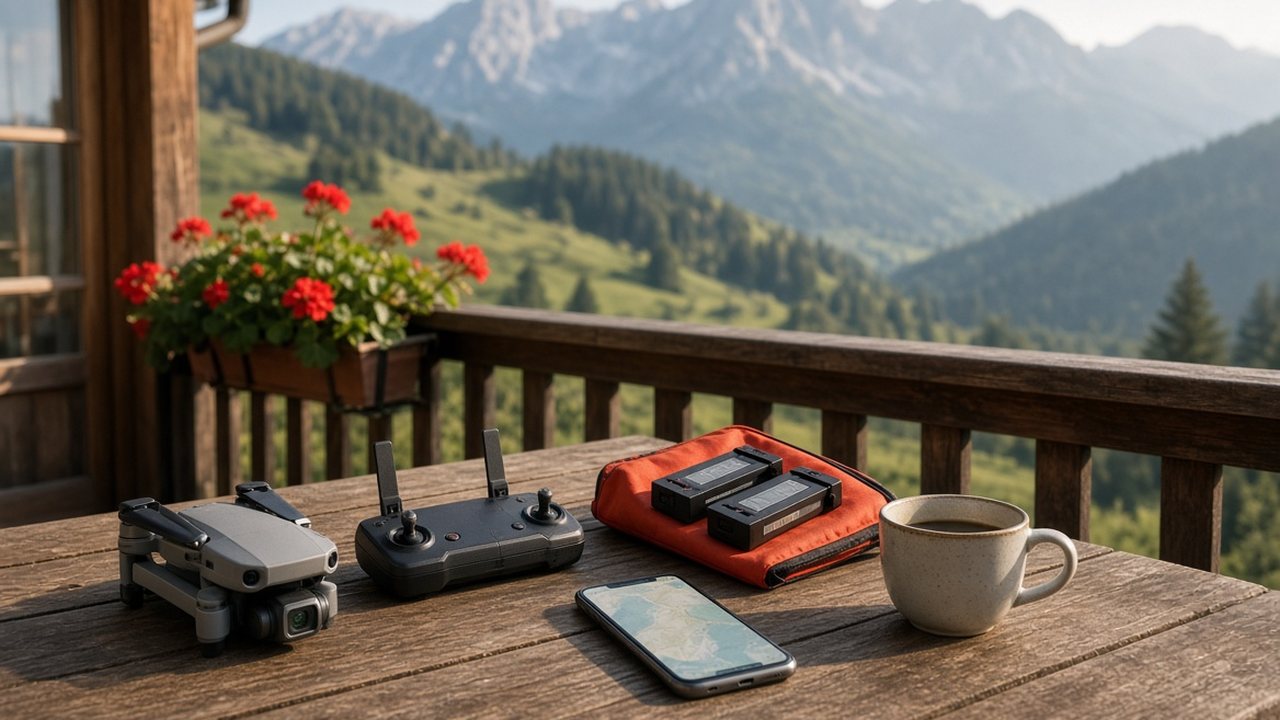
Your operator number must be visible on every drone. One option is a 20 × 8 mm aluminium plate, laser-engraved with your operator number without the three secret characters. According to the seller it is made for light drones such as the DJI Mini series or Neo.

Living outside the EU? Then you register in the first EU country you fly in. If that is Germany, registration runs through the LBA portal; you need an identity document and your insurance details [2], [5]. UK residents are included: since Brexit the United Kingdom is not an EASA member state.
The official map: dipul
Germany’s official drone map is the dipul Map Tool, part of the Digital Platform for Unmanned Aviation run for the Federal Ministry of Transport. It shows the areas where drones may only fly under certain conditions, plus temporary restrictions [8]. The map works in the browser, is free and has an English interface. Select a point and it lists the zones that apply and the permitted altitude there [9].
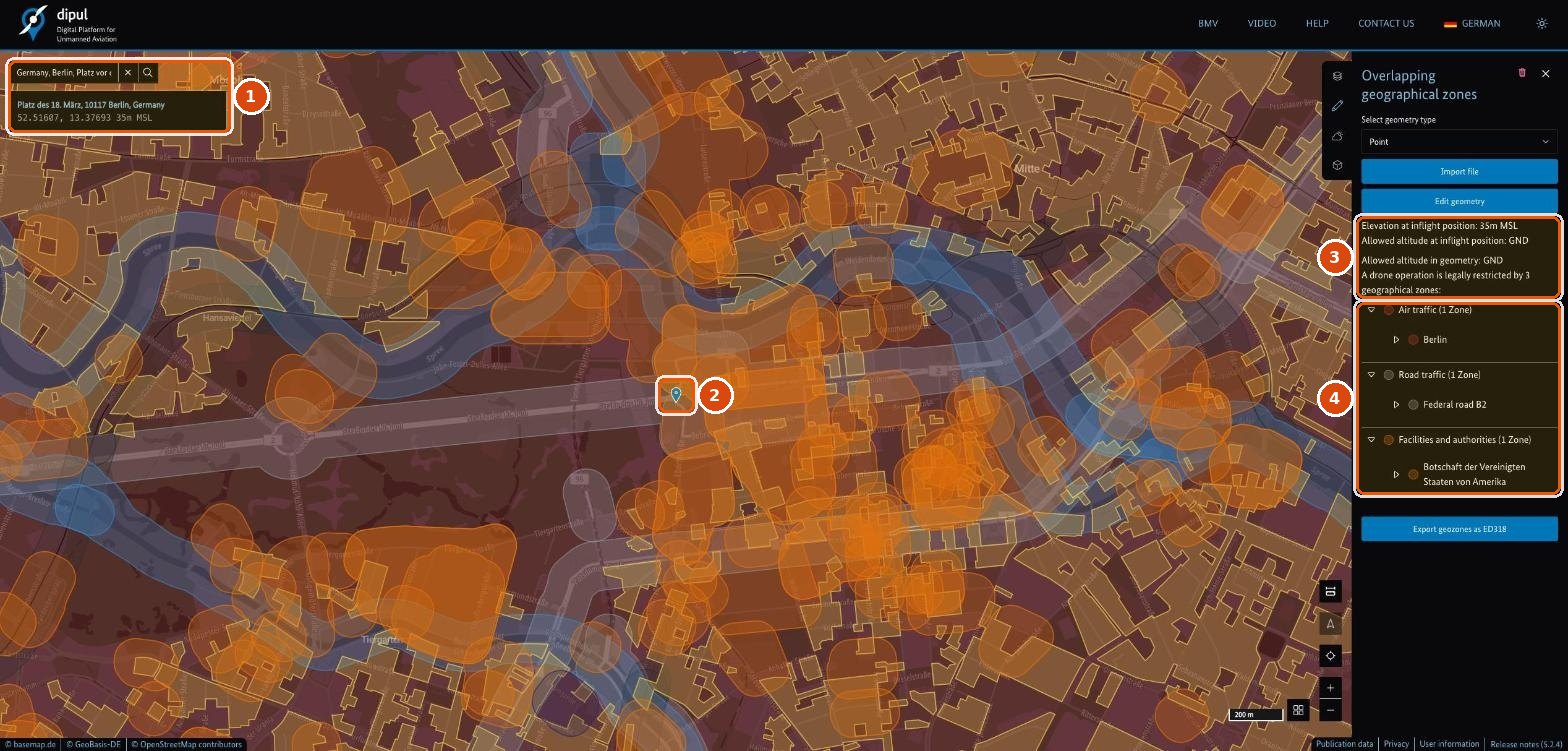
- Search for a place; here the square in front of the Brandenburg Gate.
- The selected point on the map.
- “Allowed altitude: GND” – ground level, so no flight here; the operation is restricted by three geographic zones.
- The three zones: Berlin control zone (air traffic), federal road B2 and the US Embassy.
Source: dipul, Digital Platform for Unmanned Aviation of the Federal Ministry of Transport, operated by DFS · base map basemap.de © GeoBasis-DE, © OpenStreetMap contributors · screenshot taken on 18 November 2026 · markings: drohnen.de
The no-go zones in detail
§ 21h LuftVO lists the zones where flights in the open category are only allowed under conditions. For holidaymakers, the most relevant ones are [3]:
| Area | Zone | When a flight is allowed |
|---|---|---|
| Airports | 1,000 m from the boundary, plus 1,000 m either side of the extended runway centreline for 5 km | Only in the specific category |
| Other airfields | 1.5 km from the boundary | With consent of the airfield or air supervision |
| Control zones | Area of the control zone | With air traffic control clearance |
| Federal roads, federal waterways, railways | 100 m | With consent; or height always below the lateral distance and more than 10 m away |
| Industrial sites, prisons, military sites, power plants | 100 m | Only with express consent |
| Government buildings, embassies, police | 100 m | Only with express consent |
| Hospitals | 100 m | Only with consent of the operator |
| Accident sites and emergency operations | 100 m | Only with consent of the incident commander |
Source: § 21h (3) LuftVO [3]. The list is simplified; the full conditions are in the legal text.
Nature reserves, gardens and beaches
Flying over nature reserves, national parks and Natura 2000 sites requires the express consent of the nature conservation authority. In nature reserves – not national parks – a few exceptions exist, but none for leisure flights [3].
You may only fly over residential properties with the owner’s consent, or with a drone up to 250 g that cannot record images, sound or radio signals [3].
Open-air pools, bathing beaches and similar facilities may only be overflown outside opening or bathing hours [3].
Insurance and minimum age
Germany requires the keeper of an aircraft to hold liability insurance [4]. Drones are aircraft, so this applies to every drone, whatever its weight. The LBA also asks for the insurer and policy number when residents register [5]. Our reading: as a visitor you need cover that applies in Germany; many household liability policies exclude drones, so check before you travel.
The minimum age for remote pilots in Germany is 16. There is no national reduction; younger pilots may only fly toys of class C0, home-built drones under 250 g or under the direct supervision of a qualified pilot [7].
Moving to Germany: registration with the LBA
Once you live in Germany, the Federal Aviation Office becomes your authority. Registration is required for drones from 250 g or with a camera. It costs €20 for private individuals and needs an identity document, address and your insurance details. You receive one e-ID that you attach to all your drones [5]. For the A1/A3 proof of training the LBA offers a free online course; the online test and certificate cost €25. With C0 drones and drones under 250 g it is not mandatory in A1, but recommended [6].
Portals at a glance
Official map of all geographic zones in Germany, with a point query and temporary restrictions.
For residents of Germany and visitors from outside the EU flying first in Germany.
Online training course for the A1/A3 proof of training; A2 via approved bodies.
Common mistakes on a trip to Germany
Federal roads and railways have a 100-metre zone. Many scenic valleys run right next to them [3].
Neighbouring gardens are residential properties. Without consent, overflight is not allowed with a camera drone [3].
Nature reserves and national parks need approval from the nature conservation authority. For leisure flights, there is no general exception [3].
Liability insurance is mandatory. Without it you are breaking German law even if everything else is right [4].
Germany from above: landscapes, highlights and limits
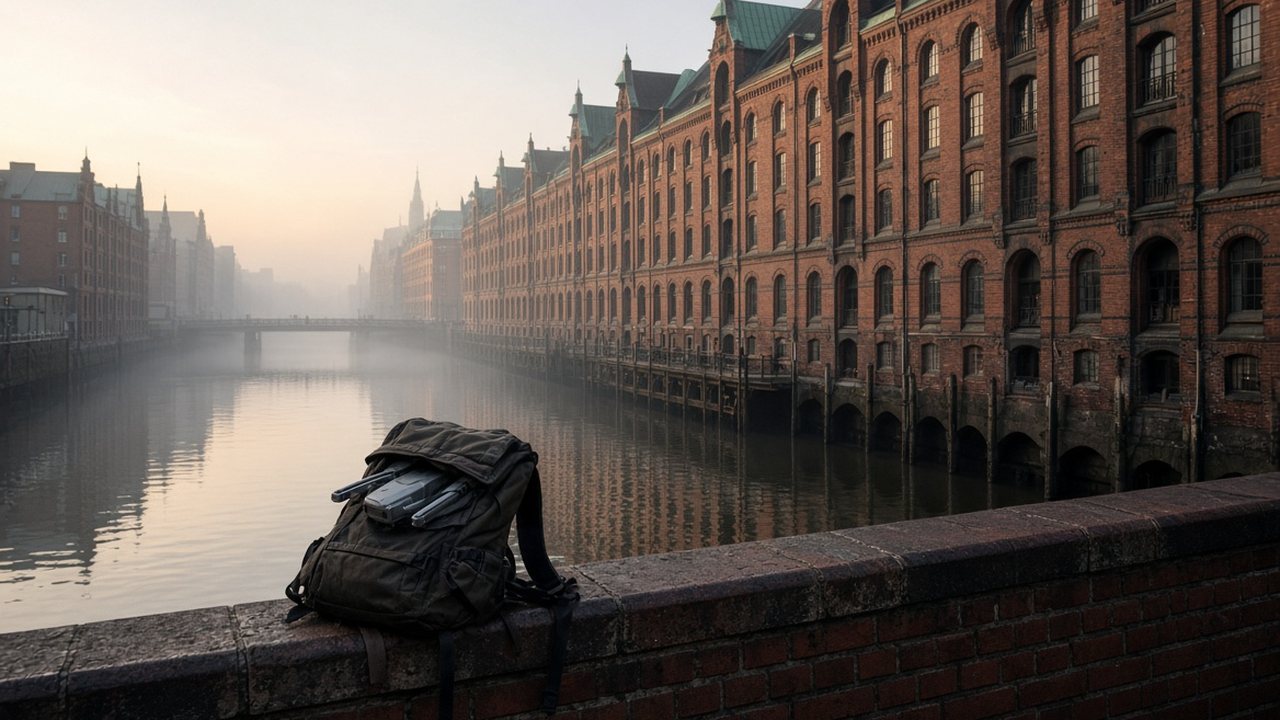
Germany stretches from the North Sea and Baltic coasts across low mountain ranges and river valleys to the Alps. The Wadden Sea, the largest unbroken system of intertidal flats in the world, is a UNESCO World Heritage Site shared with the Netherlands and Denmark [11]; so are the Upper Middle Rhine Valley with its castles and vineyards [12] and Hamburg’s Speicherstadt [13].
Many of the most photogenic places are national parks, nature reserves or lie next to rivers, railways and federal roads. In Germany each of these has its own rule in § 21h LuftVO [3], so the dipul map decides more often than the view.
Places worth seeing – and what to check
SaxonySaxon Switzerland
Sandstone towers and table mountains above the Elbe; around 94 km² of the area form a national park, one of the smallest in Germany [14].
Drone check: Drones are not allowed in the national park: its regulation bans operating model aircraft [14], [15]. The Elbe is a federal waterway with a 100 m zone.
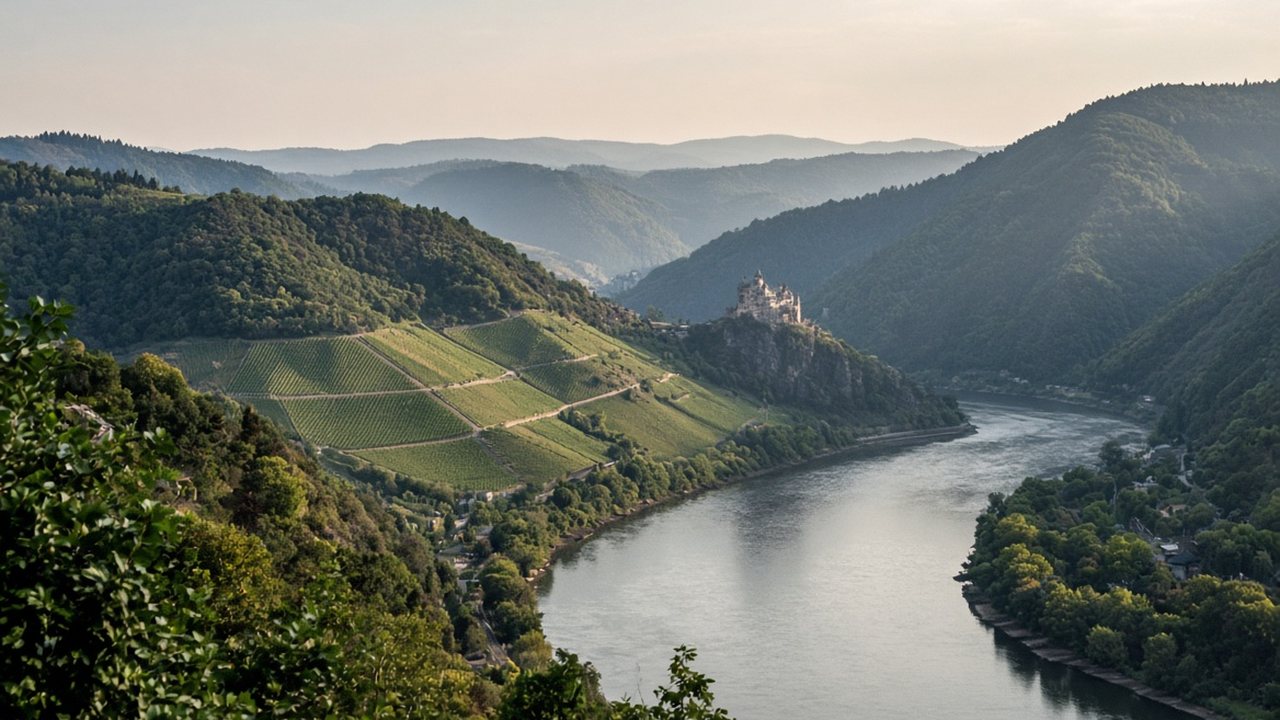
Rhineland-Palatinate and HesseUpper Middle Rhine Valley
A 65 km stretch of the Rhine with historic towns, terraced vineyards and around 40 hilltop castles – a World Heritage Site [12].
Drone check: The Rhine is a federal waterway, and railways and federal roads run along the banks: 100 m zones almost everywhere in the valley [3].
HamburgSpeicherstadt
Brick warehouses built between 1885 and 1927 on narrow islands in the Elbe, listed together with the neighbouring Kontorhaus District [13].
Drone check: Dense city centre: check dipul for control zones, waterways and buildings with their own zones before planning anything here.
Where the drone stays on the ground
Flying over a national park needs the express consent of the nature conservation authority [3]. Saxon Switzerland bans model aircraft in its regulation, and the Berchtesgaden National Park in the Alps lists “no drones” among its rules [15], [16].
Overflight requires the express consent of the nature conservation authority; there is no general exception for hobby flights [3]. Germany has a large number of protected areas, so check every spot in dipul.
Federal waterways, railways and federal roads have a 100 m zone. Many scenic valleys – the Rhine, Moselle or Elbe – combine all three [3].
Videos: drone rules in Germany and the country from above
The first three videos come from our own YouTube channel and are in German. Turn on subtitles in the YouTube player and choose “Auto-translate” to read them in English. They are written for pilots who live in Germany; as a visitor from another EU country you can skip the registration steps. Channel names, dates and running times are taken from the YouTube pages.
EU Drohnenverordnung – DJI Mini 5 Pro – Drohnen Gesetz Drohnenklasse C0 / C1
Our own explainer (transcript reviewed), using the DJI Mini 5 Pro as an example: insurance, LBA registration and ID label, no certificate needed for C0, minimum age 16 (younger pilots only under supervision), 120 m and visual line of sight. From 15:49 it covers Germany’s § 21h rules: residential properties, 1 km around airports, 100 m from federal waterways, roads, railways and power plants, and the ban over nature reserves. The map app mentioned in the video is a private service; the official map is dipul.
The video only loads from YouTube after you click (privacy-enhanced mode). Watch on YouTube
EU Drohnenverordnung – Änderungen ab 2024 für alle Drohnen und Drohnenklassen
Recorded before the EU transition period ended on 1 January 2024 (transcript reviewed): legacy drones under 250 g keep flying in A1 without a certificate, heavier drones without a class label are limited to A3 – far from people and 150 m from residential, commercial and recreational areas. It then explains classes C0, C1 and C2 and why registration and certificates are valid across the EU, with national rules on top.
The video only loads from YouTube after you click (privacy-enhanced mode). Watch on YouTube
Drohnen Gesetz: Registrierung Drohnen-Pilot beim LBA – Anleitung [ EU Drohnenverordnung ]
A walk through the LBA registration portal (transcript reviewed): you need a photo of your ID card or passport and your drone insurance policy number; the portal has a separate path for people living outside the EU. It also shows which part of the e-ID goes on the label and when the full ID with check characters is entered for Remote ID (class C1 and above). Only relevant if you live in Germany or come from outside the EU.
The video only loads from YouTube after you click (privacy-enhanced mode). Watch on YouTube
Germany 4K – Scenic Relaxation Film With Calming Music
According to the channel, a journey through Germany’s regions from the Bavarian Alps to its many castles. Music only, no narration; individual locations are not named.
The video only loads from YouTube after you click (privacy-enhanced mode). Watch on YouTube
Frequently asked questions about drones in Germany
Can I bring my drone to Germany?
Yes. Germany applies the EU drone regulation. With a valid operator registration, the operator ID on the drone, an EU pilot certificate and liability insurance you may fly in the open category, provided you respect German geographic zones.
Do I need to register in Germany as a tourist?
Not if you live in another EU country. If you live outside the EU and Germany is the first EU country you fly in, you register with the Federal Aviation Office (LBA).
Is drone insurance mandatory in Germany?
Yes. German law requires liability insurance for every aircraft, including drones of any weight. Check that your policy covers drones and applies in Germany.
Where can I see no-fly zones in Germany?
In the official dipul Map Tool (maptool-dipul.dfs.de). It is free, works in the browser and has an English interface.
Can I fly my drone in Berlin?
Hardly in the centre. Berlin lies in a control zone, and government buildings, embassies, federal roads and railways have their own 100-metre zones. At the Brandenburg Gate, for example, the map shows ground level as the permitted altitude.
Can I fly over a beach in Germany?
Only outside the bathing hours of a designated bathing beach, and never over people. Many coastal areas are also nature reserves or part of the Wadden Sea national parks.
What is the minimum age?
16. Germany has not lowered the age; exceptions apply only to toys of class C0, home-built drones under 250 g and flights under the direct supervision of a qualified pilot.
Are the rules about to change?
Possibly. In September 2026 EASA proposed registration and Remote ID from 100 g. This has not been adopted yet.
Conclusion: EU papers plus insurance, then dipul decides
For visitors from other EU countries, the paperwork is simple: home registration, ID on the drone, EU certificate. Germany adds two things that catch many travellers out: mandatory liability insurance and a dense network of 100-metre zones around roads, railways and buildings, plus strict protection of gardens and nature reserves.
The best approach is to plan your spot in the dipul map at home, check it again on site and fly in open countryside away from roads and houses.
Share
Who is flying in Germany?
Send the checklist to anyone taking a drone to Germany.
TransparencySources and data16 entries, primary sources first
- EUR-Lex: Implementing Regulation (EU) 2019/947 (legal text), accessed 17 Nov 2026.
- EASA: Travelling with drones (agency), accessed 17 Nov 2026.
- Bundesministerium der Justiz: § 21h Luftverkehrs-Ordnung (LuftVO) (legal text, German), accessed 18 Nov 2026.
- Bundesministerium der Justiz: § 43 Luftverkehrsgesetz (LuftVG) (legal text, German), accessed 18 Nov 2026.
- Luftfahrt-Bundesamt (LBA): UAS-Betreiberregistrierung (authority, German), accessed 18 Nov 2026.
- Luftfahrt-Bundesamt (LBA): Fernpilotenausbildung (authority, German), accessed 18 Nov 2026.
- Luftfahrt-Bundesamt (LBA): Fragen und Antworten zu Drohnen (authority, German), accessed 18 Nov 2026.
- dipul (BMV / DFS): Digitale Plattform Unbemannte Luftfahrt (authority, German), accessed 18 Nov 2026.
- dipul (BMV / DFS): dipul Map Tool (map application), accessed 18 Nov 2026.
- EASA: Opinion No 06/2026 (agency), 18/09/2026, proposal without legal effect.
- UNESCO: Wadden Sea (World Heritage listing), accessed 18 Nov 2026.
- UNESCO: Upper Middle Rhine Valley (World Heritage listing), accessed 18 Nov 2026.
- UNESCO: Speicherstadt and Kontorhaus District with Chilehaus (World Heritage listing), accessed 18 Nov 2026.
- Tourismusverband Sächsische Schweiz: Nationalpark Sächsische Schweiz (protected-area management), accessed 18 Nov 2026.
- Bundesministerium der Justiz: § 6 Verordnung über die Festsetzung des Nationalparks Sächsische Schweiz (authority), accessed 18 Nov 2026.
- Nationalpark Berchtesgaden: Unterwegs im Schutzgebiet – Verhaltensregeln (protected-area management), accessed 18 Nov 2026.
NotesDisclaimer and transparency
Note: This article provides general information on drone law in Germany. It does not replace legal advice or binding information from the LBA, the nature conservation authorities or air traffic control. Check the legal texts and the current dipul map before every flight. Last editorial review: 18 November 2026.
Transparency: This article was researched and written with AI assistance and checked by our editors. All photos are AI-generated illustrations and labelled as such; they do not imply permission to fly at the places shown. The screenshot comes from the official dipul map; the markings were added by us. The Amazon link is an affiliate link: if you buy through it, drohnen.de earns a commission. Your price does not change, and Amazon takes you to your local store.
Uncertainties: That visitors’ insurance must cover Germany is our reading of the keeper’s duty in § 43 LuftVG. The zone table simplifies § 21h LuftVO. The fourth video is third-party content; our own videos were recorded for pilots living in Germany and before the latest rule changes.
Transparency and editorial note: in line with the transparency requirements of Article 50 of the EU AI Act, which apply since 2 August 2026, our articles are checked, put into context and approved by our editors before publication. Final assessment and editorial responsibility rest with our editorial team.
Besides our own and supplied photos, we use illustrative images. These may be created or edited with digital tools. Where legal transparency or labelling duties apply to individual content, it is marked accordingly.

