You are reading: the EASA 100-gram proposal, with a focus on Ireland
Travelling in Europe?Open the country map
EU drone law · EASA proposal · As of 19 November 2026
EASA’s 100-gram threshold: registration, Remote ID and the A1/A3 test for mini drones
The EU Aviation Safety Agency EASA wants to lower the most important weight limit in European drone law from 250 to 100 grams – for registration, for Remote ID and for the A1/A3 online test. It is still a proposal. This guide explains what is in it, which drones would be affected, what it would mean in Ireland and what you can sensibly do today.
- Opinion 06/2026 of 18 Sep 2026
- Registration and Remote ID from 100 g
- Not yet law
What would change What it means for Ireland
AI-generated image
Status: 19 November 2026. EASA Opinion 06/2026 is a recommendation to the European Commission, not applicable law. The Commission has not decided yet; nothing changes for pilots today. Editorial information, not legal advice.
On 18 September 2026, EASA recommended in Opinion 06/2026 that registration and Remote ID should start at 100 instead of 250 grams and that the A1/A3 online test should be required from 100 grams [1]. It only becomes law once the Commission adopts the amended regulations and they are published in the Official Journal.
The essentials in 20 seconds
Registration and Remote ID would be required in the open category from 100 g. Today the threshold is 250 g; camera drones must be registered even below that [1], [5].
Member states would have to verify every operator’s identity before registration is completed [1].
Online training and online test would be required in A1 from 100 g – the same test as today for C1 drones [2].
New drones should not take off without a stored operator number. Existing drones would be exempt [2], [3].
No class label, no Remote ID and – even with a camera – no registration [2].
Registration and identity check 20 days after publication; Remote ID and A1/A3 test from 100 g twelve months after entry into force [2].
What applies today to drones under 250 grams
The basis is the same in every EU country: Implementing Regulation (EU) 2019/947 sets the operating rules, Delegated Regulation (EU) 2019/945 the product requirements and drone classes [6], [5]. For light drones, three points matter today:
Mandatory from 250 g. Below that only if the drone has a camera or another sensor that can capture personal data and is not a toy [5]. Most owners of small camera drones are therefore already registered.
No proof is needed for class C0 drones under 250 g in subcategory A1; reading the manufacturer’s instructions is enough. From class C1 you need the A1/A3 proof [5].
Mandatory for classes C1, C2, C3, C5 and C6 and in the specific category. C0 drones are exempt [1], [8].
Insurance, some minimum ages and the geographical zones are set nationally within the EU framework [6]. The EASA proposal does not change these national rules.
What EASA proposes: Opinion 06/2026 in detail
The opinion is titled “Regular update of Regulations (EU) 2019/947 and (EU) 2019/945 — Security”. It is EASA’s answer to the Action Plan on Drone and Counter-Drone Security that the European Commission presented on 11 February 2026 [1], [7]. Its main aim is to make drones and their operators easier to identify. Two draft regulations are attached: an implementing regulation amending 2019/947 and a delegated regulation amending 2019/945 [2], [3].
| Topic | Today | EASA proposal |
|---|---|---|
| Operator registration | from 250 g; below if camera or sensor and not a toy | uniformly from 100 g; camera and toy criteria dropped |
| Identity check | not required EU-wide | mandatory before registration is completed; each state sets the procedure |
| Direct Remote ID | classes C1, C2, C3, C5, C6; not C0 | all drones from 100 g |
| Drones under 100 g | registration if fitted with a camera | no class label, no Remote ID, no registration |
| Pilot competency | not needed for C0 under 250 g | online training and online test A1/A3 from 100 g |
| Start lock | none | new drones do not take off without a stored operator number |
| Minimum age | none for C0 toys in A1 | additionally none for drones under 100 g |
| New C0 drones | no Remote ID needed | built-in Remote ID, start lock and serial number to ANSI/CTA-2063-A |
| Specific category | registration and Remote ID depending on the operation | registration always; Remote ID below 120 m regardless of mass |
Sources: EASA Opinion 06/2026 and draft regulations [1], [2], [3], EASA [5], Unmanned Airspace [8].
There are also technical changes aimed mainly at manufacturers: defined tolerances between actual and declared take-off mass (2 or 3 per cent depending on the class), revised requirements for Remote ID add-on modules and a class label obligation for privately built drones flown under a standard scenario [3], [8]. For model-flying clubs, the authority may decide in the club authorisation whether models must transmit Remote ID [2], [9].
EASA did not take over two ideas from the consultation: a wider geo-awareness obligation and a separate concept for critical infrastructure. Protected sites stay within the general geographical zones; member states would have to justify that a zone is necessary and proportionate, and publish all zones in one place, machine-readable and at least in English [1], [8].
Which drones would be affected
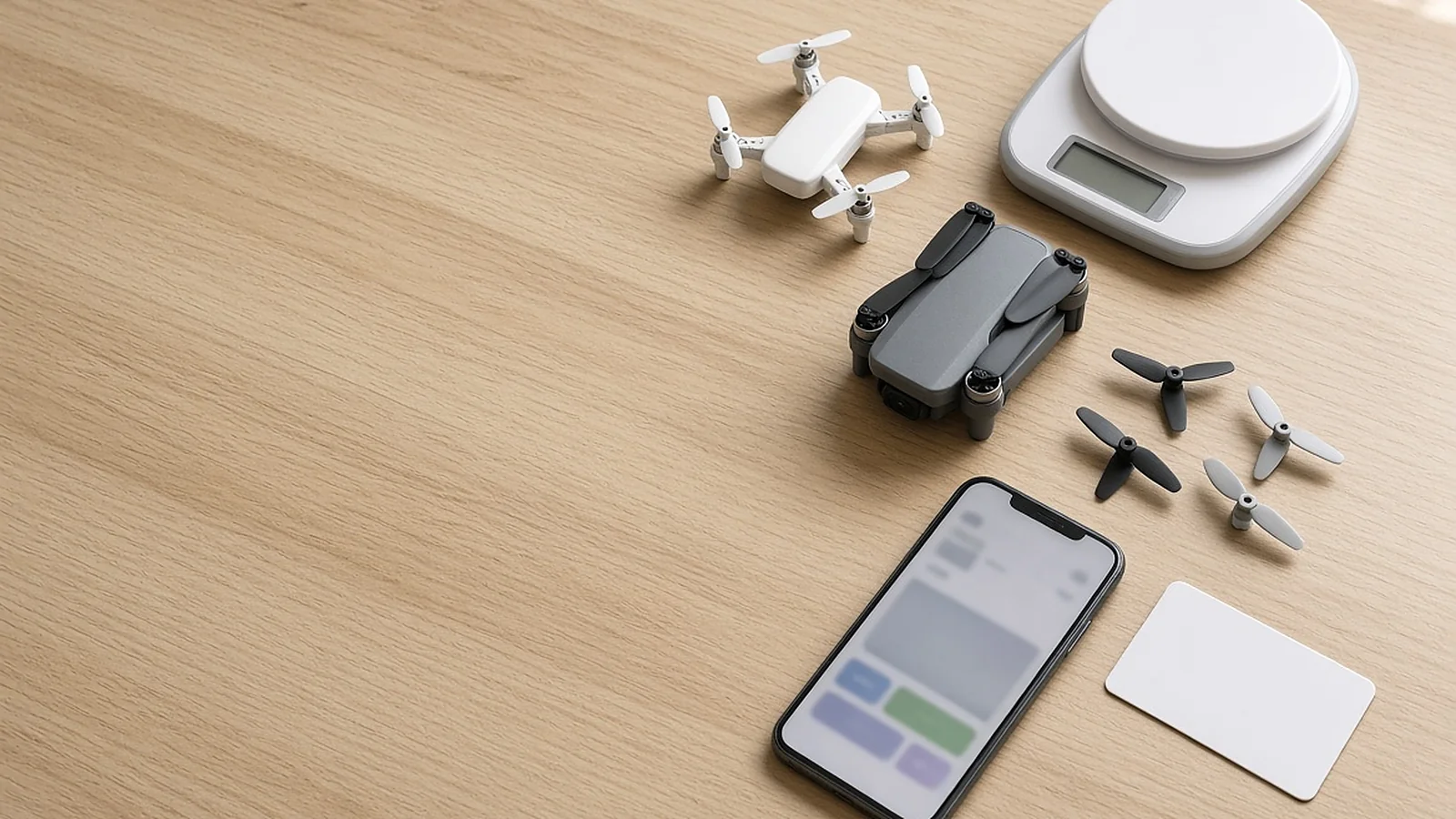
Affected would be above all camera drones between 100 and 250 grams – exactly the class that has grown fastest in recent years because it may be flown in A1 without a certificate. What counts under the draft is only the take-off mass: from 100 g a certificate, below that none [2].
| Model | Weight (manufacturer) | Class | Today | Under the draft |
|---|---|---|---|---|
| DJI Neo | about 135 g | C0 | no proof | A1/A3 required |
| DJI Neo 2 | 151 g (160 g with Digital Transceiver) | C0 | no proof | A1/A3 required |
| DJI Flip | 249 g | C0 | no proof | A1/A3 required |
| DJI Mini 4 Pro | under 249 g | C0 | no proof | A1/A3 required |
| DJI Mini 5 Pro | 249.9 g with standard battery | C0 | no proof | A1/A3 required |
| Older minis without class | under 250 g | none | no proof | A1/A3 required |
| Tiny whoops, toys | under 100 g | – | no proof | no proof, no minimum age |
| C1 drones | 250 to 900 g | C1 | A1/A3 required | unchanged |
Weights: DJI [12], [14], heliguy [13], Notebookcheck [15], Maison du Drone [16]; rule: draft implementing regulation [2].
A special case is the DJI Mini 5 Pro: with the larger battery it exceeds the C0 limit according to DJI and is no longer a C0 drone even today [14]. For most owners of small camera drones, registration would not be new – the noticeable changes would be Remote ID, the identity check and the A1/A3 test.
Remote ID from 100 grams and existing drones
With direct remote identification, the drone broadcasts its operator number, position, height and take-off point during flight. Drones with a class label have it built in; older or self-built drones need an add-on module. For drones already sold, Article 20 of the draft implementing regulation contains transitional rules. The deadlines are still in square brackets, i.e. placeholders [2]:
Placed on the market before a cut-off date twelve months after entry into force, they may keep flying without built-in Remote ID, start lock or new serial number – and without an add-on module [2], [8].
These drones would need a Remote ID add-on module 48 months after entry into force [2].
Drones sold before 2024 without a class label are not mentioned in the 900-gram exemption. On our reading of the wording, they would have to fly with active Remote ID from 100 g, i.e. with an add-on module. Whether the Commission adopts this is open [2].
Important for the timeline: according to the draft, registration from 100 g and the identity check would apply without transition, 20 days after publication in the Official Journal. Remote ID from 100 g, the A1/A3 requirement from 100 g and the new geozone rules would only apply twelve months after entry into force [2], [10].
A1/A3 test from 100 grams: what would change
The change is in point UAS.OPEN.020 of the draft implementing regulation, which governs subcategory A1. The remote pilot would have to complete online training and pass an online theory test – “except in the case of an unmanned aircraft with a take-off mass of less than 100 g”. Today, the exemption at this point covers C0 drones [2].
The test itself would stay the same: 40 multiple-choice questions spread across nine subjects, passed with 75 per cent. It is the same online test that every C1 pilot already takes today; the proof is valid for five years throughout the EU [2], [5]. The nine subjects and what is typically behind them:
Distance to people and other aircraft, recognising risks, priority of manned aviation.
Geographical zones and no-fly areas, for example around airports.
EU drone regulation, categories, duties of operator and remote pilot.
Fatigue, alcohol, medication, distraction and the limits of visual range.
Flight preparation, pre-flight checks, loss of link and emergencies.
Battery, satellite navigation, return-to-home, weather.
What you may film, personal rights, handling of recordings.
Why liability cover matters and what national law requires.
Preventing misuse, protecting critical infrastructure, reporting incidents.
For children the draft brings one relief: remote pilots generally have to be at least 16, but there would be no minimum age for drones under 100 g, as is already the case today for C0 toy drones. For a child flying a Neo, nothing would improve [2].
Timeline: from action plan to new regulation
| Date | Step | What it means |
|---|---|---|
| 11 Feb 2026 | Commission action plan | Calls for more traceability, including registration and Remote ID from 100 g |
| 18 May 2026 | Consultation NPA 2026-103 | EASA proposals on simplification and security; workshop on 16 June |
| Aug–Sep 2026 | Member states | The advisory body of the member states gives its opinion |
| 18 Sep 2026 | Opinion 06/2026 | EASA hands its recommendation and draft regulations to the Commission |
| Q4 2026 | Second opinion announced | Simplifications, e.g. more room in the open category |
| open | Commission decision | Entry into force 20 days after publication; Remote ID and A1/A3 from 100 g twelve months later |
Sources: EASA [1], [4], Commission [7], DroneXL [10].
How long the road to applicable law will take is open. As of 19 November 2026, the Commission has not adopted the amended regulations and has not announced a date. Until then, today’s rules with the 250-gram threshold continue to apply [1], [9].
What it would mean for Ireland
The EASA proposal would apply directly in all EU countries, including Ireland. The Irish Aviation Authority (IAA) would remain responsible for registration, the online test and the geographical zones. What would change is the threshold – what stays the same are the national rules that the opinion does not touch, such as insurance. Our comparison, based on the IAA’s current information [17], [18], [19]:
| Topic | Today in Ireland | Under the proposal |
|---|---|---|
| Authority | Irish Aviation Authority (IAA) [17] | unchanged |
| Registration | Via MySRS from 250 g or with camera; MySRS already checks name and age [18] | from 100 g regardless of camera; identity check before registration |
| A1/A3 proof | “UAS Proof of online Training” on MySRS, valid five years [19] | needed in A1 from 100 g, twelve months after entry into force |
| Insurance | Mandatory except for recreational flights under 20 kg; IAA recommends it [18] | not covered by the opinion – Irish rule unchanged |
| Minimum age | No minimum age in Irish aviation regulation; registration from 16, parents register for children [18] | draft: no age limit for drones under 100 g |
| Night flying | Allowed with a green flashing light [18] | not covered by the opinion |
Sources: IAA [17], [18], [19]; proposal: EASA [1], [2]. The right-hand column is our reading of the draft.
MySRS already verifies name and age at registration [18]. How Ireland would implement the EU-wide identity check is not yet known.
Anyone flying a camera drone in Ireland today is usually already registered. New would be the A1/A3 proof on MySRS and Remote ID for new drones from 100 g [2], [19].
Registrations and certificates from any EU country remain valid in Ireland [18]. The 100-gram threshold would apply to visitors in the same way.
The opinion does not regulate insurance. The Irish rule – mandatory except for recreational flights under 20 kg – would remain [18].
All other Irish rules – airport zones, the ban at Office of Public Works heritage sites, temporary restricted areas – are explained in our guide Flying a drone in Ireland. For Malta, the second English-speaking EU country, see Flying a drone in Malta.
The UK already has a 100-gram rule
The United Kingdom has already taken this step. Since 1 January 2026, pilots there need a Flyer ID with a theory test for drones from 100 g, and owners of camera drones from 100 g also need an Operator ID [11]. Anyone travelling from Ireland or the continent to England, Scotland or Northern Ireland with a mini drone has to follow these rules today. A detailed overview (in German) is available in our article on the UK drone rules 2026.
Criticism and open questions
Model-flying associations and self-builders consider the 100-gram threshold disproportionate. EASA sticks to it and points out that the value comes from the Commission’s action plan [1], [9].
For nano drones, Remote ID from 100 g is a noticeable restriction. Below 100 g, the proposal would instead remove obligations [2], [8].
What you can do now
If your drone has a camera and is not a toy, you must already be registered and display the operator number. In Ireland: MySRS [18].
In Ireland insurance is mandatory except for recreational flights under 20 kg; the IAA recommends it for everyone [18].
The online training does no harm, is valid for five years and would be required from 100 g under the proposal [2], [5].
A new drone with a class label and Remote ID is on the safe side – existing class-labelled drones up to 900 g would be exempt from retrofitting.
The threshold does not change where you may fly. Check the IAA zones before every flight [17].
Your operator number must be visible on every drone. One option is a 20 × 8 mm aluminium plate, laser-engraved with your operator number without the three secret characters. According to the seller it is made for light drones such as the DJI Mini series or Neo.

Your drone would not become unusable. Existing drones would be exempt from the start lock and, up to 900 g with class label, from retrofitting [2].
Frequently asked questions about the 100-gram threshold
Does the 100-gram threshold already apply?
No. On 18 September 2026 EASA only gave a recommendation to the European Commission. Until the Commission amends the regulations, today’s rules with the 250-gram threshold apply.
Do I need to register my DJI Neo now?
Yes, but not because of the new threshold: the Neo has a camera and is not a toy, so it already requires registration under current law. New would be Remote ID and the A1/A3 proof.
Will I soon need a certificate for a drone under 250 grams?
Under the draft, yes, if it weighs 100 g or more: online training and online test A1/A3, twelve months after the new rules enter into force. Today no proof is needed for C0 drones.
Will the test get harder?
According to the draft, no. It remains 40 multiple-choice questions on nine subjects with a 75 per cent pass mark.
Do I have to retrofit Remote ID?
Not if the drone has a class label, weighs up to 900 g and was sold before the cut-off date. Drones over 900 g would need a module after 48 months. For older drones without a class label, the wording provides no exemption.
What happens to drones under 100 grams?
They would be relieved: no class label, no Remote ID in the open category and no registration, even with a camera. Insurance rules and flight rules still apply.
What does the proposal change in Ireland?
Registration on MySRS would be required from 100 g, plus the A1/A3 proof in A1 and Remote ID for new drones. The IAA remains responsible; insurance and zone rules are not affected by the opinion.
Do the A1, A2 and A3 flight rules change too?
Not through this opinion. EASA has announced a second opinion on simplifications in the open category for the fourth quarter of 2026.
Conclusion: the 250-gram freedom would shrink – but not today
EASA wants to lower the threshold for registration and Remote ID from 250 to 100 grams, have every operator’s identity checked, stop new drones without an operator number from taking off and require the A1/A3 test from 100 grams. Drones under 100 grams would be relieved. The European Commission decides; there is no date yet.
In Ireland, the IAA and MySRS would remain the point of contact. Anyone who is registered, has the A1/A3 proof and knows the zones today is already well prepared for the new rules.
Share
Know someone with a mini drone?
Send them the overview of the planned 100-gram rules.
Black Friday: looking for a small drone or a DJI camera? The prices we checked and current deals are in Black Friday 2026: DJI drone and camera deals.
TransparencySources and data19 entries, primary sources first
We checked the planned rules against the wording of the two draft regulations attached to the opinion and compared them with independent specialist reports. The Irish rules come from the Irish Aviation Authority. All sources accessed on 19 November 2026.
- EASA: Opinion No 06/2026 – Regular update of Regulations (EU) 2019/947 and (EU) 2019/945 – Security (EU agency, primary source), 18 Sep 2026, proposal without legal effect.
- EASA: Annex I: draft implementing regulation amending Regulation (EU) 2019/947 – Art. 14, Art. 20, UAS.OPEN.020, Art. 9, Art. 2 (primary source).
- EASA: Annex II: draft delegated regulation amending Regulation (EU) 2019/945 – class labels, Remote ID, start lock, tolerances (primary source).
- EASA: NPA 2026-103 – Simplification and security (consultation, primary source).
- EASA: Training requirements in the open category – today’s rules on registration and competency (EU agency).
- EUR-Lex: Implementing Regulation (EU) 2019/947 (legal text).
- European Commission: Action Plan on Drone and Counter-Drone Security, COM(2026) 81 (as German Bundesrat print 146/26, PDF) (primary source).
- Unmanned Airspace: EASA proposes wide range of amended rules to tighten security of drone operations (trade media).
- PickDrones: EASA Proposes Cutting Drone Registration to 100g (trade media).
- DroneXL: EASA NPA 2026-103: drone registration from 100 grams (trade media).
- DroneXL: EU action plan: 100-gram threshold, UK rule since 1 January 2026 (trade media).
- DJI: Neo 2 – specs (manufacturer).
- heliguy: DJI Neo 2 vs DJI Neo (retailer, trade source).
- DJI: Mini 5 Pro – specs (manufacturer).
- Notebookcheck: DJI Flip im Test (trade media, in German).
- Maison du Drone: DJI Mini 5 Pro vs. Mini 4 Pro (retailer, in German).
- Irish Aviation Authority: UAS Geographical Zones (authority).
- Irish Aviation Authority: Safety & Regulations – FAQs (authority) – registration, insurance, minimum age, night flying.
- Irish Aviation Authority: Drone training – remote pilot competency (authority) – A1/A3 proof on MySRS, renewal every five years.
Uncertainties: these are drafts; the Commission may change them. All deadlines (12 and 48 months) are in square brackets in the draft, i.e. placeholders. The statement on older drones without a class label and the right-hand column of the Ireland table are our reading of the wording.
NotesDisclaimer and transparency
Note: this article provides general information on a proposal by EASA and on the current rules in Ireland. It is not legal advice. Only the regulations published in the Official Journal of the EU and the information of the Irish Aviation Authority are binding. Last editorial check: 19 November 2026.
Transparency: this article was researched and written with AI support and checked by our editors. The images are AI-generated illustrations and labelled as such; they do not show specific models. The Amazon link is an affiliate link: if you buy through it, drohnen.de receives a commission. Your price does not change, and Amazon redirects you to the store for your country.
This article combines our two German articles on the EASA 100-gram threshold and on the A1/A3 proof from 100 grams.
Transparency and editorial note: in line with the transparency requirements of Article 50 of the EU AI Act, which apply since 2 August 2026, our articles are checked, put into context and approved by our editors before publication. Final assessment and editorial responsibility rest with our editorial team.
Besides our own and supplied photos, we use illustrative images. These may be created or edited with digital tools. Where legal transparency or labelling duties apply to individual content, it is marked accordingly.

